You’ve probably typed “lieing or lying” at least once and paused, wondering which one is actually correct. It’s a small detail, but it matters especially if you care about writing clearly and professionally. The truth is simple: one is correct, the other isn’t.
In this guide, we’ll break down lieing or lying, explain the correct spelling, explore meanings, and show how to use it properly in real-life sentences. By the end, you won’t hesitate again.
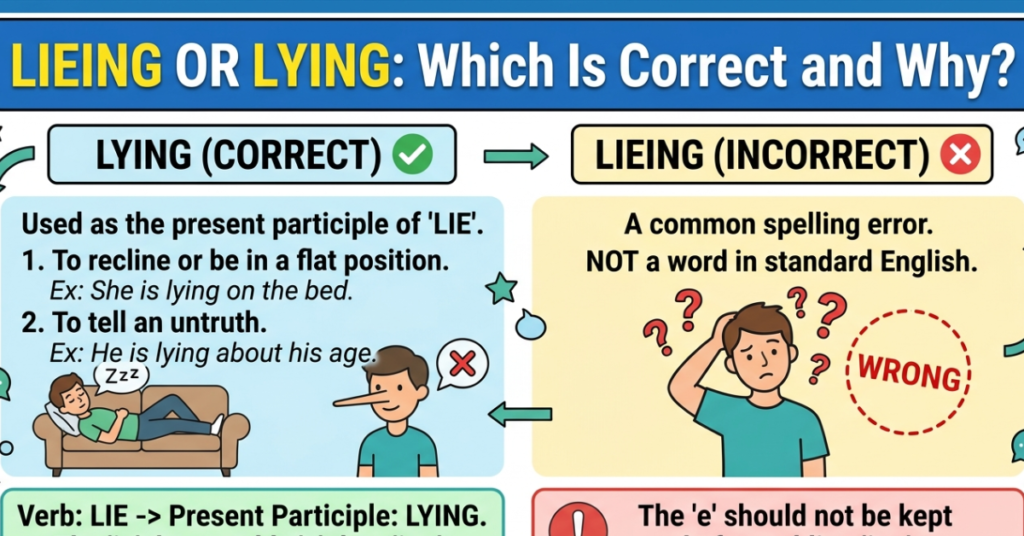
Lieing or Lying: Which Is Correct?
Let’s settle this quickly:
- Lying is correct
- Lieing is incorrect
The confusion comes from how English handles verbs ending in “-ie.” When you add “-ing,” the “ie” changes to “y.”
Example:
- Lie → Lying
- Die → Dying
- Tie → Tying
So if you’re asking, “is it lieing or lying?” — the answer is always lying.
Lieing or Lying Meaning (What Does “Lying” Actually Mean?)
The word lying can have two completely different meanings depending on context:
1. Not telling the truth
This is the most common usage.
Examples:
- He is lying about where he was last night.
- Stop lying—just tell the truth.
2. Being in a horizontal position
This refers to resting or reclining.
Examples:
- She is lying on the couch.
- The cat is lying in the sun.
Context is everything. Same spelling, different meaning.
Lieing or Lying Down: What’s Correct?
If you’re talking about resting or reclining, the correct phrase is:
- Lying down
- Lieing down
Examples:
- I’m lying down because I feel tired.
- He was lying down when the phone rang.
There’s no situation where “lieing down” is correct—none.
Why Do People Confuse Lieing and Lying?
This mistake is extremely common, and here’s why:
1. English spelling rules are inconsistent
Not every verb follows the same pattern, so people guess.
2. Pronunciation doesn’t help
“Lieing” sounds like it could be right—even though it isn’t.
3. Autocorrect sometimes misses it
Some tools don’t flag “lieing” as wrong, reinforcing the mistake.
Quick Grammar Rule You Should Remember
When a verb ends in -ie, replace it with -y before adding -ing.
Simple Formula:
ie → y + ing
Examples:
- Lie → Lying
- Die → Dying
- Tie → Tying
Stick to this rule, and you’ll avoid this mistake every time.
Common Mistakes and How to Fix Them
Here are typical errors people make with lieing or lying:
Incorrect:
- She is lieing on the bed.
- He kept lieing to everyone.
Correct:
- She is lying on the bed.
- He kept lying to everyone.
Lying vs Laying (Bonus Tip You Actually Need)
Now here’s where things get tricky. People often mix up lying and laying.
Key Difference:
- Lying = resting (no object needed)
- Laying = putting something down (needs an object)
Examples:
- I am lying on the sofa.
- I am laying the book on the table.
If there’s no object involved, you want lying.
When Should You Use “Lying”?
Use lying when:
- Someone isn’t telling the truth
- Someone or something is resting/reclining
Quick checklist:
- Talking about honesty? → lying
- Talking about position? → lying
- Wondering about spelling? → always lying, never lieing
FAQs About Lieing or Lying
1. Is it lieing or lying?
It is always lying. “Lieing” is incorrect.
2. What is the meaning of lying?
“Lying” can mean either not telling the truth or being in a resting position.
3. Why is lieing wrong?
Because English spelling rules require “ie” to change to “y” before adding “-ing.”
4. How do you spell lying down?
The correct spelling is lying down, not “lieing down.”
5. Is lying and laying the same?
No. “Lying” means resting, while “laying” means placing something somewhere.
Conclusion
If you remember just one thing from this guide, make it this: “lying” is always correct, and “lieing” is always wrong.
This isn’t a gray area—there’s no exception. Understanding the simple spelling rule and the two meanings of “lying” will clean up your writing instantly.