Ever paused mid-sentence wondering whether to write bearer or barer? You’re not alone. These two words sound identical, but they mean completely different things—and using the wrong one can quietly wreck your credibility.
In this guide, we’ll break down bearer or barer, explain when to use each, and give you simple tricks so you never mix them up again. By the end, you’ll have clarity—and confidence—every time you write.
What Does “Bearer” Mean?
Definition of Bearer
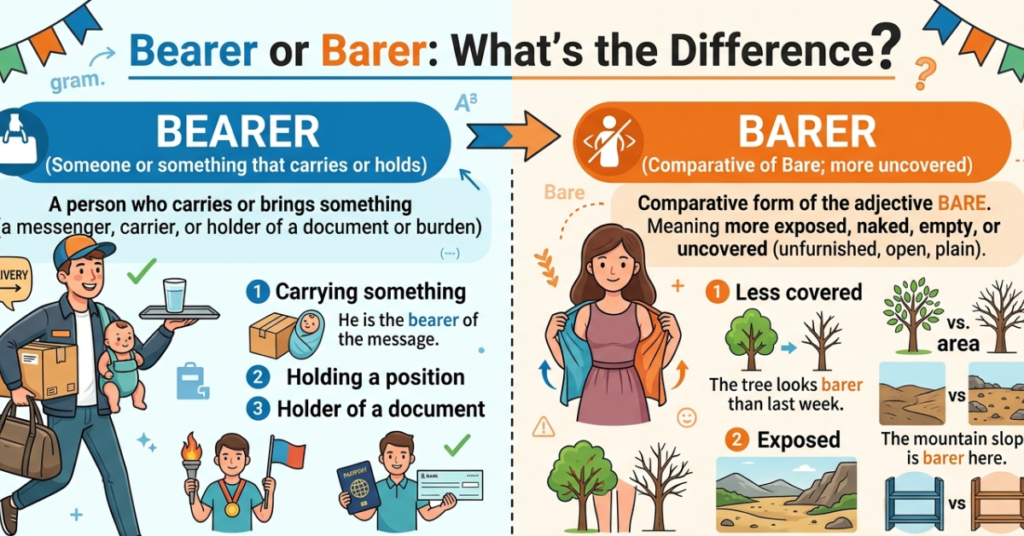
“Bearer” refers to a person or thing that carries, holds, or conveys something.
Common Uses of Bearer
You’ll usually see “bearer” in formal, financial, or descriptive contexts:
- Bearer of news: Someone delivering information
- Bearer token: A digital authentication term
- Bond bearer: A person holding a financial instrument
Example Sentences
- He was the bearer of good news.
- The document must be presented by the bearer.
- She became the torch bearer for the campaign.
Think of bearer = carrier. That’s your shortcut.
What Does “Barer” Mean?
Definition of Barer
“Barer” is the comparative form of “bare,” meaning more exposed, more uncovered, or more minimal.
Common Uses of Barer
“Barer” is less common but still useful in descriptive writing:
- Physical exposure
- Minimal design
- Simplicity or lack of covering
Example Sentences
- The room looked barer after removing the furniture.
- His explanation was even barer than before.
- The tree seemed barer in winter.
Think of barer = more bare (more empty or exposed).
Bearer or Barer: Key Differences
Let’s simplify the confusion:
| Word | Meaning | Usage Type |
| Bearer | Someone who carries something | Noun |
| Barer | More exposed or uncovered | Comparative adjective |
Quick Memory Trick
- If it involves carrying → bearer
- If it involves less covering → barer
When to Use Bearer (With Tips)
Use bearer when referring to responsibility, possession, or delivery.
Situations Where “Bearer” Fits:
- Financial documents
- Official roles
- Symbolic responsibilities
Pro Tip
If you can replace the word with holder or carrier, “bearer” is correct.
When to Use Barer (With Tips)
Use barer when comparing something that has become more exposed or minimal.
Situations Where “Barer” Fits:
- Descriptions of physical objects
- Visual comparisons
- Writing about simplicity
Pro Tip
If “more bare” makes sense, then “barer” is your word.
Common Mistakes People Make
Here’s where people mess up:
Incorrect:
- He is the barer of the message.
Correct: He is the bearer of the message.
Incorrect:
- The room became bearer after renovation.
Correct: The room became barer after renovation.
The mistake usually happens because both words sound identical.
Bearer or Barer in Everyday Writing
In reality, “bearer” is far more commonly used than “barer.”
You’ll see “bearer” in:
- Business writing
- Legal documents
- Tech (like bearer tokens)
“Barer,” on the other hand, shows up more in:
- Creative writing
- Descriptive passages
FAQs About Bearer or Barer
1. Is “barer” a real word?
Yes, “barer” is a correct comparative form of “bare,” though it’s less commonly used.
2. Which is more commonly used: bearer or barer?
“Bearer” is used much more frequently, especially in formal contexts.
3. Can bearer and barer be used interchangeably?
No. They have completely different meanings and cannot replace each other.
4. How do I quickly remember the difference?
- Bearer → carry
- Barer → more bare
5. Is “bearer” used in technology?
Yes, terms like “bearer token” are widely used in authentication systems.
Conclusion
The confusion between bearer or barer comes down to sound—not meaning. Once you understand the difference, it’s actually simple:
- Use bearer when talking about carrying or holding something
- Use barer when describing something more exposed or minimal
If you write regularly—whether for school, business, or online content—getting this right matters more than you think. Small mistakes can chip away at credibility.