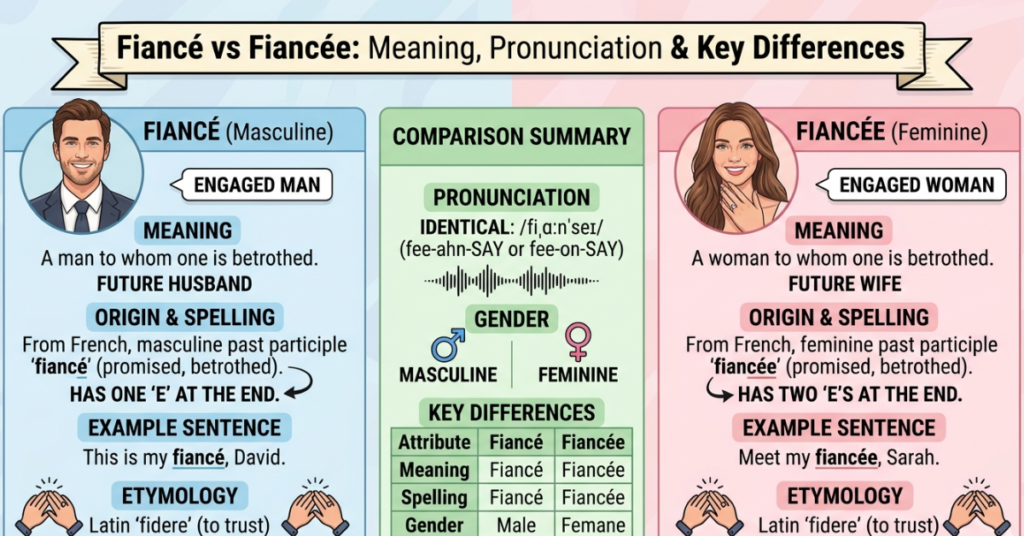
Confusion often arises when people encounter fiance vs fiancee, mainly because the words look almost identical and sound the same. However, a small spelling change creates an important difference in meaning, which comes from French grammar rules.
To clear up this confusion, this guide explains the meaning, pronunciation, and correct usage in a simple and practical way.
What does fiance vs fiancee mean?
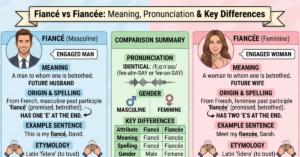
At its core, fiance vs fiancee meaning depends on gender, and this distinction comes directly from French.
- Fiancé refers to a man who is engaged to be married
- Fiancée refers to a woman who is engaged to be married
Because English borrowed both terms from French, it kept this gender-based spelling.
Example in context:
- My fiancé is planning our wedding ceremony.
- Her fiancée helped choose the engagement ring.
Notice how the meaning changes clearly depending on the spelling used.
Pronunciation of fiance vs fiancee
Although spelling differs, pronunciation does not change much, which often confuses learners.
Both words are pronounced:
- Fiancé → fee-ahn-SAY
- Fiancée → fee-ahn-SAY
Interestingly, English speakers rarely adjust pronunciation based on spelling differences here. As a result, context and spelling become the only reliable way to distinguish them.
Spelling difference explained simply
The key difference lies in just one letter, yet that single letter carries meaning.
- Fiancé → ends with one “e”
- Fiancée → ends with two “e’s”
Because of this small variation, readers can immediately identify gender in written communication.
Helpful memory trick:
To remember easily:
- One “e” refers to a male partner
- Two “e’s” indicate a female partner
How to use fiance vs fiancee correctly
Proper usage becomes simple once you apply the gender rule consistently.
Use fiancé when:
- Referring to a male partner engaged to be married
- Writing formal or professional announcements
Use fiancée when:
- Referring to a female partner engaged to be married
- Writing wedding captions or invitations
In both cases, context helps reinforce clarity, especially in written communication.
Common mistakes people make
Even experienced writers occasionally misuse these terms, especially in informal settings.
1. Mixing gender forms
She is my fiancé (In correct)
She is my fiancée (Correct)
2. Dropping accents entirely
Some people write “fiance” for both genders. Although common online, this reduces grammatical accuracy in formal writing.
3. Assuming pronunciation changes
Despite spelling differences, pronunciation stays the same, which often misleads learners.
Why fiance vs fiancee causes confusion
Several linguistic reasons explain why this pair is tricky:
- Both words originate from French
- English does not usually use gendered nouns
- Pronunciation remains identical
- Only spelling separates meaning
Therefore, readers often rely on context rather than sound.
Modern usage in everyday English
In today’s digital communication, many people simplify spelling for convenience. However, formal writing still prefers traditional usage.
For example, journalists, wedding planners, and academic writers continue to use the correct forms to maintain clarity and professionalism.
Even so, casual conversations and social media sometimes ignore the distinction without causing major confusion.
Helpful image alt text examples (SEO-friendly)
To improve accessibility and SEO, images should include descriptive alt text such as:
- “fiance vs fiancee meaning explained with examples”
- “fiance vs fiancee pronunciation guide chart”
- “difference between fiancé and fiancée spelling illustration”
These help search engines better understand your content.
FAQs
1. What is fiance vs fiancee meaning?
The meaning depends on gender: fiancé is male, fiancée is female.
2. Do fiancé and fiancée sound different?
No, both are pronounced the same: fee-ahn-SAY.
3. Can I use fiance for everyone?
You can in informal writing, but it is not grammatically correct in formal English.
4. Why does fiancée have an extra “e”?
The extra “e” comes from French grammar rules that indicate feminine form.
5. Is this distinction still important today?
Yes, especially in formal writing such as invitations and published content.
Conclusion
Understanding fiance vs fiancee becomes easy once you remember a simple rule: spelling defines gender, while pronunciation stays the same. With just one extra letter, the meaning changes completely.
As a result, using the correct form helps you communicate more clearly and professionally, especially in formal writing or wedding-related content.
If you keep practicing with real examples, this small grammar distinction will quickly become second nature.