English has plenty of confusing word pairs, but few trip people up as often as accept vs except. Since the two words sound very similar, many writers accidentally use one when they really mean the other. Even fluent English speakers sometimes pause to double-check which spelling fits the sentence.
The good news is that the difference is actually simple once you understand the meaning behind each word. “Accept” relates to receiving or agreeing, while “except” refers to excluding something. This guide explains the meanings, grammar rules, examples, pronunciation differences, and practical usage tips so you can confidently use both words correctly.
What Does “Accept” Mean?
“Accept” is a verb that means:
- To receive something willingly
- To agree to something
- To approve or admit something as true
The word usually involves saying “yes” to something.
Common Examples of Accept
- She accepted the job offer.
- I accept your apology.
- The store accepts credit cards.
- He accepted the invitation to dinner.
In every example, someone receives, agrees with, or approves something.
What Does “Except” Mean?
“Except” is usually a preposition or conjunction that means:
- Excluding
- Other than
- Leaving out
The word creates an exception.
Common Examples of Except
- Everyone came except John.
- I like all fruits except bananas.
- The store opens daily except Sunday.
- She answered every question except the last one.
Here, something or someone is being excluded.
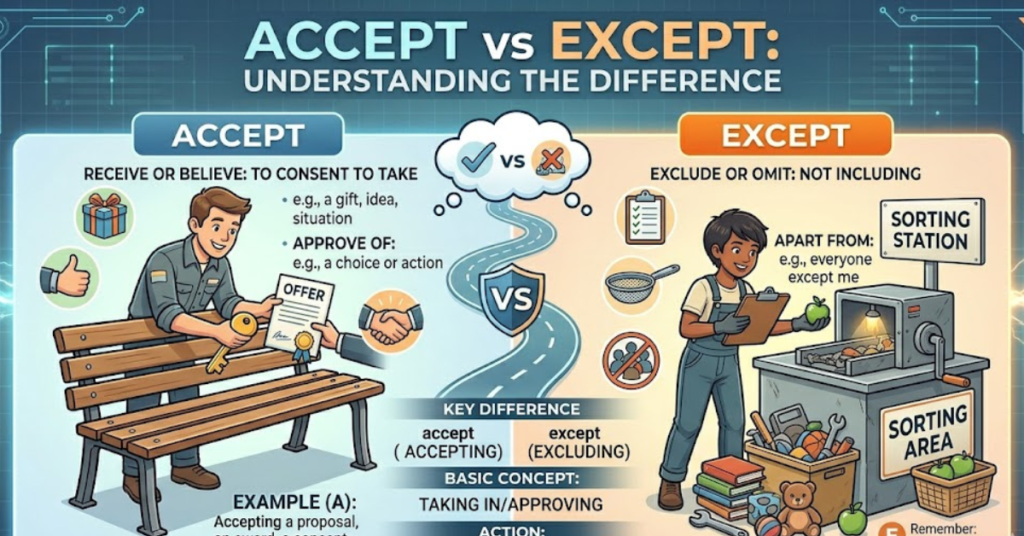
Accept vs Except Meaning Explained
Understanding accept vs except meaning becomes easier if you focus on the action happening in the sentence.
Accept
- Means to receive or agree
- Positive inclusion
Except
- Means to exclude or leave out
- Separation or omission
A simple memory trick is:
- Accept = “yes”
- Except = “not included”
Accept vs Except Difference in Grammar
Although the words sound alike, they function differently in grammar.
Accept as a Verb
“Accept” performs an action.
Examples:
- They accepted the proposal.
- She accepts responsibility.
Except as a Preposition or Conjunction
“Except” connects ideas involving exclusion.
Examples:
- Everyone attended except Mark.
- I eat everything except seafood.
Understanding their grammatical roles helps prevent mistakes.
Why These Words Are Commonly Confused
Several factors make these words tricky.
Similar Pronunciation
The words sound nearly identical in casual speech.
Similar Spelling
Only two letters differ.
Fast Reading and Typing
People often rely on sound rather than meaning while writing quickly.
English Learning Challenges
Non-native speakers may struggle because both words appear frequently in conversation.
Because of these similarities, context matters more than pronunciation.
Accept vs Except Examples in Everyday Sentences
Real-world examples make the distinction clearer.
Correct Uses of Accept
- He accepted the award proudly.
- The university accepted her application.
- They accepted the new policy.
Correct Uses of Except
- Everyone passed except one student.
- The shop is open every day except Monday.
- I cleaned every room except the kitchen.
Each sentence clearly shows either inclusion or exclusion.
Accept vs Except Usage Tips
A few simple strategies can help you choose the correct word quickly.
Use “Accept” When Something Is Received
Think about:
- Accepting gifts
- Accepting offers
- Accepting ideas
Use “Except” When Something Is Left Out
Think about:
- Exceptions
- Exclusions
- Omissions
The meanings become much easier once you connect them to these core ideas.
Accept vs Except vs Expect
People sometimes confuse these words together because they sound similar.
Accept
To receive or agree.
Except
To exclude.
Expect
To anticipate or believe something will happen.
Examples
- I accept your apology.
- Everyone came except Sam.
- I expect the package tomorrow.
Although pronunciation overlaps slightly, the meanings are very different.
Common Mistakes to Avoid
These mistakes appear often in emails, essays, and social media posts.
Incorrect
- Everyone came accept Tom.
- I except your invitation.
Correct
- Everyone came except Tom.
- I accept your invitation.
The first sentence requires exclusion, while the second requires agreement.
Accept vs Except Pronunciation
The pronunciation difference is subtle.
Accept
Usually pronounced:
- ak-SEPT
Except
Usually pronounced:
- ik-SEPT
In fast speech, the sounds may blend together, which contributes to confusion.
Simple Memory Tricks
Memory shortcuts can make these words easier to remember.
Accept = Approval
The “A” in accept can remind you of:
- Agree
- Approve
- Accept
Except = Exclusion
The “EX” in except can remind you of:
- Exclude
- Exception
These quick associations help during writing.
Practice Sentences for Better Understanding
Try identifying the correct word.
- I will ___ your decision.
- Everyone arrived ___ the manager.
- She gladly ___ the promotion.
- The restaurant serves all dishes ___ pork.
Answers
- Accept
- Except
- Accepted
- Except
Practice helps reinforce correct usage naturally.
Commonly Confused Words Similar to Accept and Except
English contains several similar word pairs.
Frequently Confused Examples
- Affect vs effect
- Than vs then
- Your vs you’re
- Principal vs principle
Like accept and except, these pairs require understanding meaning rather than relying only on pronunciation.
Why Correct Usage Matters
Using the wrong word can change the entire meaning of a sentence.
Correct grammar helps:
- Improve clarity
- Strengthen professionalism
- Build writing confidence
- Prevent misunderstandings
This matters in academic, business, and everyday communication.
FAQs
What is the difference between accept and except?
“Accept” means to receive or agree, while “except” means to exclude or leave out.
How do I remember accept vs except?
Think of “accept” as approval and “except” as exclusion.
Is except a verb?
Usually no. “Except” is most commonly a preposition or conjunction.
Can accept and except be used interchangeably?
No. They have completely different meanings.
Which sentence is correct: accept me or except me?
“Accept me” is correct because it refers to approval or inclusion.
Why are accept and except confusing?
They sound similar and have closely related spellings, making them easy to mix up.
Conclusion
Understanding the difference between accept vs except can instantly improve your writing clarity and grammar accuracy. While the words sound similar, their meanings are completely different. “Accept” involves receiving, agreeing, or approving, whereas “except” refers to excluding or leaving something out.
Once you connect accept with inclusion and except with exclusion, choosing the correct word becomes much easier. Small grammar distinctions like this may seem minor, but they can greatly affect how your writing is understood.
By practicing real examples and remembering a few simple rules, you can confidently avoid one of the most common English language mistakes.