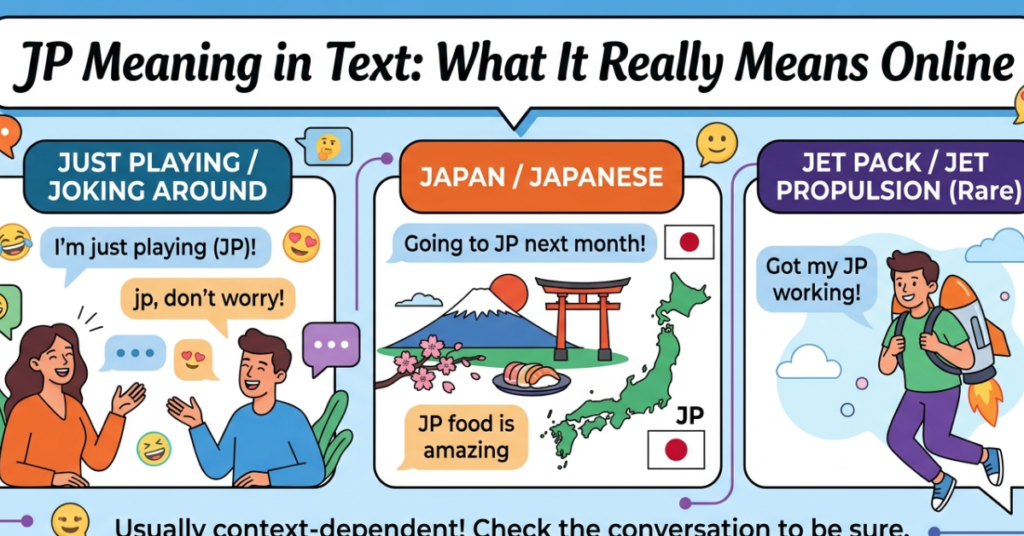
You’ve probably seen “JP” pop up in a message and paused for a second—what does that even mean? In today’s fast-paced digital conversations, abbreviations like JP meaning in text can easily confuse anyone who isn’t in the loop.
This article breaks it all down in plain English. You’ll learn what “JP” stands for, how people actually use it in conversations, and when you should (or shouldn’t) use it yourself.
What Does JP Mean in Text?
The most common JP meaning in text is:
“Just Playing”
It’s used to clarify that someone is joking, teasing, or not being serious.
Example:
- “You’re the worst player ever JP!”
- “I hate you… JP, relax!”
In both cases, “JP” softens the message so it doesn’t come off as rude or offensive.
Why People Use JP in Messages
Let’s be real—texting removes tone. Without facial expressions or voice, jokes can land badly. That’s where “JP” comes in.
Key reasons people use JP:
- Avoid misunderstandings
- Show humor or sarcasm
- Keep conversations light
- Prevent conflict
Think of it as a quick safety net after a risky joke.
Other Possible Meanings of JP
While “Just Playing” is the most common meaning, context matters. Depending on the situation, “JP” can mean other things.
Less common meanings include:
- Japanese (JP) – Referring to Japan or its language
- Jackpot – In gaming or betting contexts
- Job Position – In professional discussions
Example:
- “This product ships from JP” → Japan
- “I hit the JP!” → Jackpot
Bottom line: Always read the full message before assuming.
How to Use JP Correctly in Texting
Using JP in text messages is simple—but misuse can make you sound awkward or unclear.
Best practices:
- Use it after a joke
- “You owe me $100… JP
- Keep it casual
- Works best in friendly chats, not formal emails
- Don’t overuse it
- If every sentence ends with JP, it loses meaning
When NOT to Use JP
Here’s where people mess up. “JP” doesn’t belong everywhere.
Avoid using JP in:
- Professional emails
- Serious conversations
- Arguments or emotional situations
Bad example:
- “Your performance is disappointing. JP.”
That just confuses the message and makes you look unprofessional.
JP vs Other Slang Terms
To really understand JP meaning in text, compare it with similar slang.
| Slang | Meaning | Usage |
| JP | Just Playing | Light teasing |
| JK | Just Kidding | More common, similar tone |
| LOL | Laughing Out Loud | Expressing humor |
| SMH | Shaking My Head | Disapproval |
“JP” and “JK” are basically cousins—“JK” is just more widely used.
Real-Life Examples of JP in Conversations
Here’s how it actually shows up in chats:
Example 1:
- Friend: “You’re so slow bro”
- You: “Wow okay ”
- Friend: “JP ”
Examples 2:
- “I’m never talking to you again… JP!”
Example 3:
- “You failed the test? JP, I know you topped it.”
Notice the pattern—JP always follows a statement that could be taken seriously.
Is JP Still Popular?
Short answer: Yes, but it’s not the top slang anymore.
“JK” has largely taken over because it’s simpler and more widely recognized. Still, JP meaning in text remains relevant, especially in casual chats and certain online communities.
FAQs About JP Meaning in Text
1. What does JP stand for in texting?
JP usually means “Just Playing”, used to show that a message is a joke.
2. Is JP the same as JK?
Almost. Both mean joking, but JK (Just Kidding) is more commonly used.
3. Can JP have multiple meanings?
Yes. It can also mean Japan, Jackpot, or Job Position, depending on context.
4. Is JP formal or informal?
It’s strictly informal and should only be used in casual conversations.
5. Why do people use JP?
To avoid misunderstandings and make sure jokes aren’t taken seriously.
Conclusion
Understanding the JP meaning in text isn’t complicated—you just need context. Most of the time, it simply means “Just Playing”, helping people keep conversations light and friendly.
If you’re texting friends, go ahead and use it when joking around. But in serious or professional settings, skip it—clarity always beats slang.