Some word mix-ups are obvious, while others quietly slip into writing without being noticed. If you’ve ever paused over acceptions vs exceptions, you’re not alone. These two words look similar, sound alike, and can easily be confused—but they mean very different things.
In this guide, we’ll break down the meaning, usage, and differences so you can confidently choose the right word every time.
Acceptions vs Exceptions: What’s the Difference?
At first glance, both words may seem interchangeable, but they serve completely different purposes.
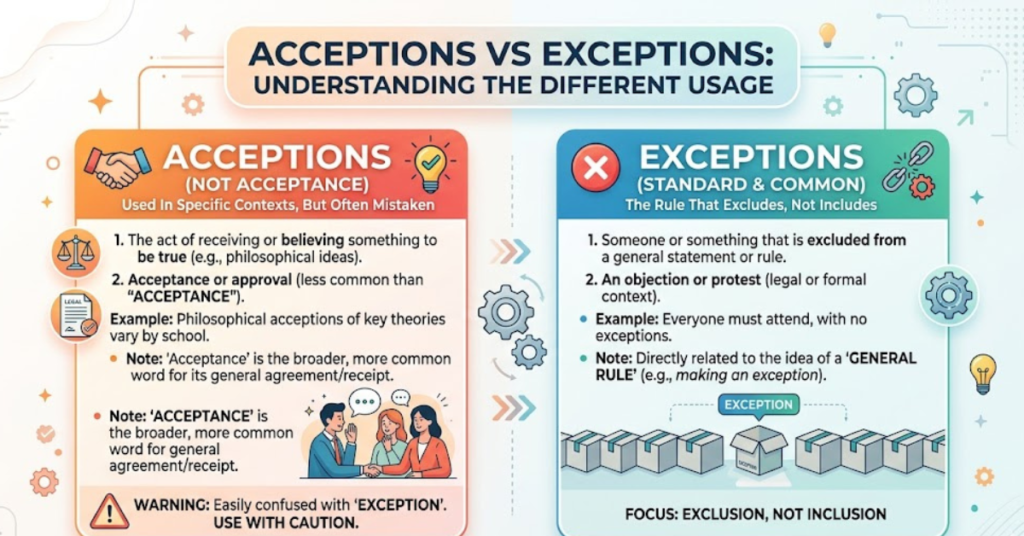
- Exceptions refers to things that don’t follow a rule
- Acceptions is a rare and specialized word related to meanings of a term
Understanding this distinction is key when dealing with acceptions vs exceptions in writing.
What Does “Exceptions” Mean?
“Exceptions” is the more common and widely used word.
Definition
- Something that does not follow a general rule
- A case that is excluded from a statement
Examples
- Everyone passed the test, with a few exceptions
- The rule applies to all students, no exceptions
- There are exceptions to every guideline
In most everyday situations, this is the word you’re looking for.
What Does “Acceptions” Mean?
“Acceptions” is much less common and often misunderstood.
Definition
- Different meanings or interpretations of a word
This term is mainly used in linguistics or academic discussions.
Examples
- The word has several acceptions in different contexts
- Scholars studied the various acceptions of the term
Because it’s so rare, many people assume it’s a misspelling.
Why People Confuse Acceptions and Exceptions
The confusion is understandable.
Common Reasons
- Both words sound similar
- They share similar spelling patterns
- “Acceptions” is rarely used, making it unfamiliar
As a result, people often use “exceptions” when they actually mean something else—or assume “acceptions” is incorrect.
When to Use Exceptions in Everyday Writing
In most cases, you’ll use “exceptions.”
Common Situations
- Rules and policies
- General statements with limitations
- Everyday conversations
Example:
- There are no exceptions to this rule
If you’re unsure, “exceptions” is usually the safer and correct choice.
When to Use Acceptions (Rare Cases)
“Acceptions” is used in very specific contexts.
Appropriate Use
- Academic writing
- Linguistics or language studies
- Discussions about word meanings
Example:
- The term has multiple acceptions depending on context
Outside of these areas, it’s rarely needed.
Quick Tips to Remember the Difference
Here are some easy ways to keep them straight:
- Exceptions = breaking a rule
- Acceptions = meanings of a word
- If it’s about rules, use “exceptions”
- If it’s about language meanings, “acceptions” might apply
These simple tips can prevent confusion.
Common Mistakes to Avoid
Even experienced writers can mix these up.
Watch Out For
- Using “acceptions” when you mean “exceptions”
- Assuming “acceptions” is always incorrect
- Overcomplicating simple writing
In most cases, sticking with “exceptions” is the right move.
FAQs
What is the difference between acceptions vs exceptions?
“Exceptions” refers to rule-breaking cases, while “acceptions” refers to meanings of a word.
Is “acceptions” a real word?
Yes, but it is rare and mainly used in academic contexts.
Which word is more common?
“Exceptions” is far more commonly used in everyday language.
Can I use “acceptions” instead of “exceptions”?
No, they are not interchangeable.
How can I remember the difference?
Think of “exceptions” as rule-related and “acceptions” as meaning-related.
Conclusion
Understanding acceptions vs exceptions comes down to context. “Exceptions” is the word you’ll use most often when talking about rules or exclusions, while “acceptions” is a specialized term used in discussions about meanings and language.
The key takeaway is simple: if you’re writing for everyday use, stick with “exceptions.” Save “acceptions” for technical or academic contexts. With this clarity, you can avoid confusion and write with confidence every time.