Some English words can trip you up in the simplest sentences. Take filed vs filled—two words that look almost identical but mean completely different things. A single missing “l” can change your entire sentence.
In this guide, we’ll break down the filed vs filled meaning, explain their differences, and show you exactly how to use each word correctly in everyday writing.
Filed vs Filled: What’s the Difference?
At a glance, these words seem interchangeable, but they serve different purposes.
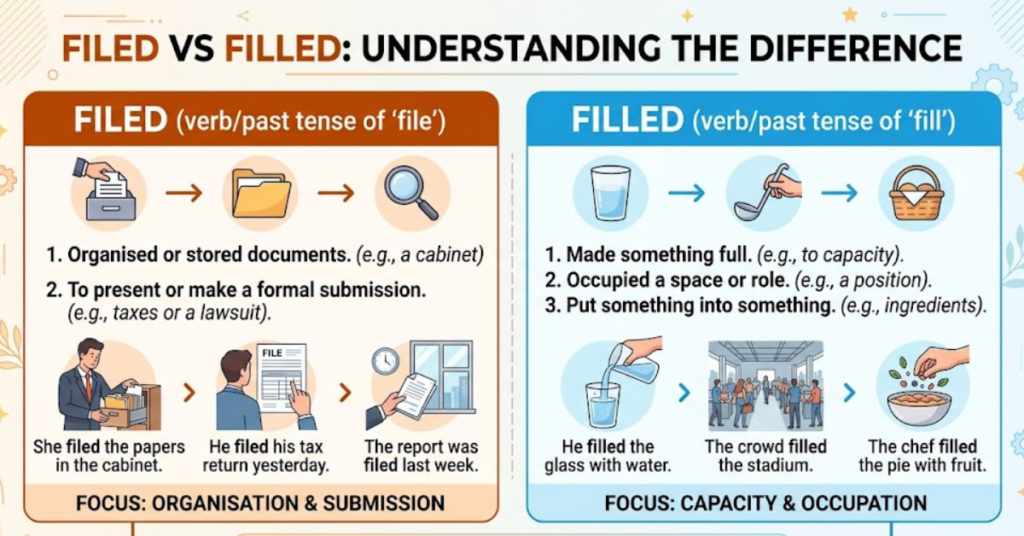
- Filed relates to organizing or submitting something
- Filled means making something full
Understanding the filed vs filled difference helps you avoid awkward or incorrect sentences.
What Does “Filed” Mean?
“Filed” is the past tense of the verb “file.”
Definition
- To submit a document or application
- To organize papers or records
- To smooth or shape something using a tool
Common Examples
- She filed the paperwork before the deadline
- He filed a complaint with the company
- The documents were neatly filed in a cabinet
In most cases, “filed” is used in professional or administrative contexts.
What Does “Filled” Mean?
“Filled” is the past tense of the verb “fill.”
Definition
- To make something full
- To occupy space or capacity
- To satisfy a need or requirement
Common Examples
- The glass was filled with water
- The room quickly filled with people
- She filled out the application form
This word is commonly used in everyday situations.
Filed vs Filled Meaning in Simple Terms
Here’s an easy way to remember:
- Filed = submitted or organized
- Filled = made full or completed
Even though they sound similar, their meanings are not interchangeable.
Common Mistakes to Avoid
Mixing up these words can lead to confusing sentences.
Incorrect Usage Examples
- I filled a complaint yesterday
- She filed the glass with juice
Corrected Versions
- I filed a complaint yesterday
- She filled the glass with juice
Pay attention to context—it usually makes the correct choice obvious.
When to Use “Filed” in Sentences
Use “filed” when dealing with documents, records, or formal actions.
Situations Where “Filed” Fits
- Legal or official paperwork
- Office or administrative tasks
- Complaints, reports, or applications
Example:
- He filed his taxes on time
When to Use “Filled” in Sentences
Use “filled” when something is made full or completed.
Situations Where “Filled” Fits
- Physical objects (glass, container)
- Emotional or descriptive contexts
- Completing forms or spaces
Example:
- The bucket was filled with water
Quick Tips to Remember the Difference
Here are simple tricks to keep them straight:
- Think of filed as paperwork or organization
- Think of filled as something becoming full
- Check the context of your sentence
- Replace the word mentally to see if it makes sense
These small checks can prevent common errors.
Why Filed vs Filled Confusion Happens
The confusion comes down to a few key factors:
- Similar spelling (only one letter difference)
- Similar pronunciation in fast speech
- Both are past tense verbs
Because of this, even experienced writers occasionally mix them up.
FAQs
What is the difference between filed vs filled?
“Filed” means submitted or organized, while “filled” means made full or completed.
Can “filed” and “filled” be used interchangeably?
No, they have completely different meanings and uses.
How do I remember filed vs filled meaning?
Associate “filed” with documents and “filled” with fullness or completion.
Is “filled out a form” correct?
Yes, “filled out” is correct when completing a form.
What is a common mistake with these words?
Saying “filled a complaint” instead of “filed a complaint.”
Conclusion
Understanding filed vs filled is all about context. While they may look similar, their meanings are distinct and not interchangeable. “Filed” deals with documents and formal actions, while “filled” describes making something full or complete.
The next time you’re writing, take a moment to double-check which word fits your sentence. Getting it right not only improves clarity but also makes your writing more polished and professional.