Some spelling mistakes are easy to catch—but others can slip right through, especially when they look like real words. If you’ve ever wondered about oversite vs oversight, you’re not alone. It’s a common confusion that can change the meaning of your sentence entirely.
In this guide, we’ll break down the oversite vs oversight meaning, explain the correct usage, and give you practical examples so you can avoid this mistake in your writing.
Oversite vs Oversight: Which Is Correct?
Let’s clear things up right away.
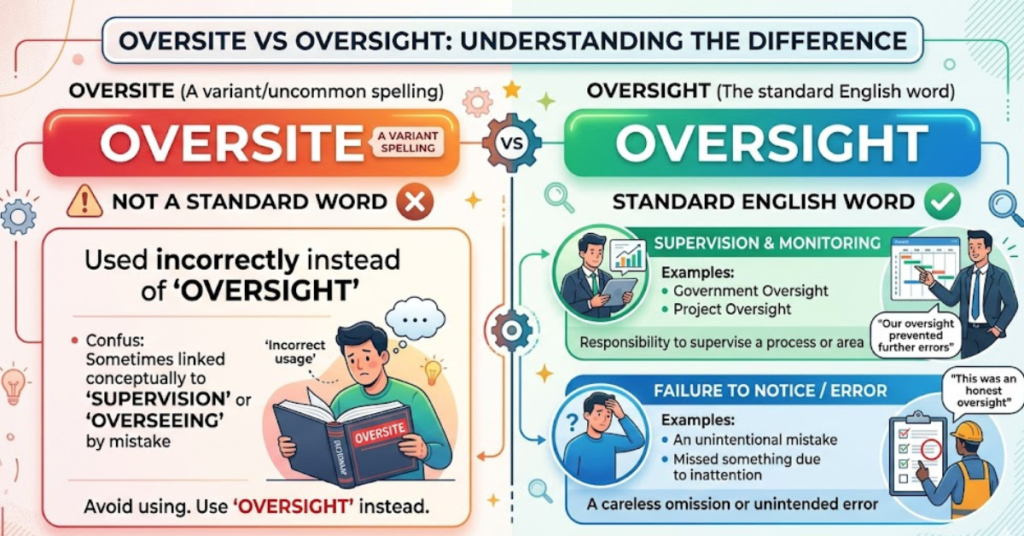
- Oversight is the correct and widely accepted word
- Oversite is usually a misspelling
So, when comparing oversite vs oversight, “oversight” is almost always the word you’re looking for.
What Does “Oversight” Mean?
“Oversight” is a versatile noun with two main meanings.
1. Supervision or Management
This is the most common usage.
- The project requires careful oversight
- The manager provides oversight for the team
In this context, it refers to monitoring or supervising something. This is often discussed in oversite vs oversight supervision scenarios.
2. An Unintentional Mistake
Interestingly, “oversight” can also mean the opposite—missing something.
- The error was due to an oversight
- It was an unfortunate oversight in the report
So, the word can mean both careful supervision and accidental omission, depending on context.
What About “Oversite”?
“Oversite” is not a standard English word in most cases.
When It Might Appear
- As a typo for “oversight”
- Rarely, as a literal combination of “over” and “site” (not commonly used)
In everyday writing, “oversite” should be avoided.
Oversite vs Oversight Meaning Explained
Here’s a simple breakdown:
- Oversight = supervision or a mistake
- Oversite = incorrect spelling (in most cases)
This clears up the oversite vs oversight meaning and helps you choose the right word.
Oversite vs Oversight Examples
Seeing the words in context makes the difference clearer.
Correct Usage
- The team worked under strict oversight
- Missing the deadline was an oversight
- The committee provides financial oversight
Incorrect Usage
- The team worked under strict oversite
- That was an oversite in the report
These oversite vs oversight examples show why spelling matters.
Oversight as a Verb: Is It Possible?
You might wonder about oversite vs oversight verb usage.
Important Note
- “Oversight” is primarily a noun
- The verb form is “oversee”
Example
- She oversees the entire operation
So instead of using “oversight” as a verb, use “oversee.”
Why People Confuse Oversite and Oversight
The mix-up is very common.
Reasons
- The words look almost identical
- Fast typing leads to missing letters
- “Oversight” has multiple meanings, which adds confusion
Because “oversite” looks plausible, it often goes unnoticed.
Quick Tips to Remember the Difference
Here are some simple ways to avoid mistakes:
- “Oversight” includes “sight”, meaning to see or watch
- Think of supervision—someone “watching over”
- If it refers to a mistake or management, use “oversight”
- Avoid “oversite” altogether
These tips can help you remember the correct form easily.
Common Mistakes to Avoid
Even small spelling errors can impact clarity.
Watch Out For
- Writing “oversite” instead of “oversight”
- Using “oversight” incorrectly as a verb
- Misunderstanding its dual meaning
Always double-check context when using the word.
FAQs
What is the difference between oversites vs oversights?
“Oversight” is the correct word, while “oversite” is usually a misspelling.
What does “oversight” mean?
It can mean supervision or an unintentional mistake.
Is “oversite” ever correct?
No, it is not standard English in most contexts.
Can “oversight” be used as a verb?
No, the verb form is “oversee.”
Why is “oversight” confusing?
Because it has two opposite meanings depending on context.
Conclusion
When it comes to oversite vs oversight, the answer is clear—“oversight” is the correct and meaningful word, while “oversite” is typically just a spelling mistake. Understanding its dual meaning—both supervision and error—helps you use it more effectively.
The key takeaway is simple: if your sentence involves monitoring, management, or even a missed detail, “oversight” is the word you need. With this clarity, you can write more confidently and avoid a common but noticeable mistake.