English spelling has a way of keeping even experienced writers on their toes. If you’ve ever hesitated between cancellation vs cancelation, you’re in good company. It’s one of those tricky word pairs where both versions seem possible—but only one is widely accepted.
In this guide, we’ll explore the cancellation vs cancelation spelling difference, explain which version is correct, and show you how to use it confidently in everyday writing.
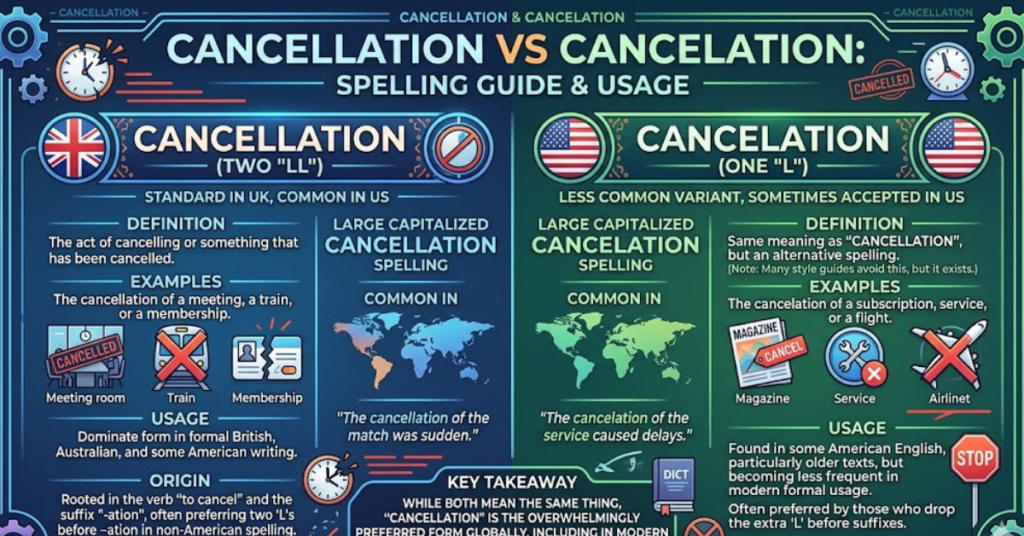
Cancellation vs Cancelation: Which Is Correct?
Let’s get straight to the point.
- Cancellation (with double “l”) is the standard and correct spelling
- Cancelation (with one “l”) is a less common variant
So when choosing between cancellation vs cancelation, “cancellation” is the safer and more widely accepted option.
Why Does “Cancellation” Have Two L’s?
The spelling rule comes from how English forms words from verbs.
The Base Word
- The verb is cancel
When adding “-ation,” the final “l” is typically doubled in British English—and often in American English as well.
Result
- Cancel + ation = cancellation
This explains the cancellation vs cancelation spelling pattern.
Is “Cancelation” Ever Correct?
Technically, yes—but with a caveat.
What You Should Know
- “Cancelation” appears in some American English usage
- It is far less common than “cancellation”
- Most dictionaries and style guides prefer “cancellation”
In professional, academic, or formal writing, sticking with “cancellation” is the best choice.
Cancellation vs Cancelation Spelling Difference
The difference is small but important.
Key Points
- Cancellation = standard, widely accepted
- Cancelation = alternative, rarely used
- Both come from the same root word
This clears up the cancellation vs cancelation spelling difference in a simple way.
Usage in British and American English
Spelling preferences can vary by region.
British English
- Strong preference for cancellation
American English
- “Cancellation” is still more common
- “Cancelation” may appear occasionally
Regardless of region, “cancellation” is the safer and more professional choice.
Examples of Correct Usage
Seeing the word in context makes it easier to remember.
Common Sentences
- The flight cancellation was unexpected
- Please confirm your cancellation request
- There is a cancellation fee for late changes
Using “cancellation” ensures clarity and correctness in all these examples.
Why People Get Confused
There are a few reasons this mix-up happens.
Common Causes
- The verb “cancel” has only one “l”
- Inconsistent spelling patterns in English
- Exposure to both versions online
Because English isn’t always predictable, this confusion is understandable.
Quick Tips to Remember the Correct Spelling
Here are some easy ways to avoid mistakes:
- Think: “cancel” becomes cancellation with double “l”
- When in doubt, double the “l”
- Use what looks more familiar—usually “cancellation”
- Stick to one spelling consistently
These simple tips can help you write with confidence.
Common Mistakes to Avoid
Even small spelling errors can stand out.
Watch Out For
- Writing “cancelation” in formal documents
- Switching between both spellings in one text
- Assuming both are equally accepted
Consistency and accuracy matter, especially in professional writing.
FAQs
What is the difference between cancellation vs cancelation?
“Cancellation” is the standard spelling, while “cancelation” is a less common variant.
Which spelling is correct?
“Cancellation” is the correct and widely accepted form.
Is “cancelation” wrong?
It’s not strictly wrong, but it’s rarely used and not preferred.
Why does “cancellation” have two L’s?
Because the final “l” is doubled when adding “-ation.”
Which spelling should I use in formal writing?
Always use “cancellation” for clarity and professionalism.
Conclusion
When it comes to cancellation vs cancelation, the choice is clear—“cancellation” is the standard, widely accepted spelling across both British and American English. While “cancelation” may appear occasionally, it’s not the preferred form in most contexts.
The key takeaway is simple: stick with “cancellation” to keep your writing accurate, consistent, and professional. Once you get used to the double “l,” this common spelling confusion becomes easy to avoid.