“Manuel or Manual” — they look almost identical, but using the wrong one can instantly make your writing look careless. This is one of those small mistakes that quietly damages credibility, whether you’re writing an email, an assignment, or content for the web.
Here’s the deal: “manual” and “Manuel” are completely different words with different meanings. In this guide, you’ll learn the difference, how to use each correctly, and how to avoid this mistake for good.
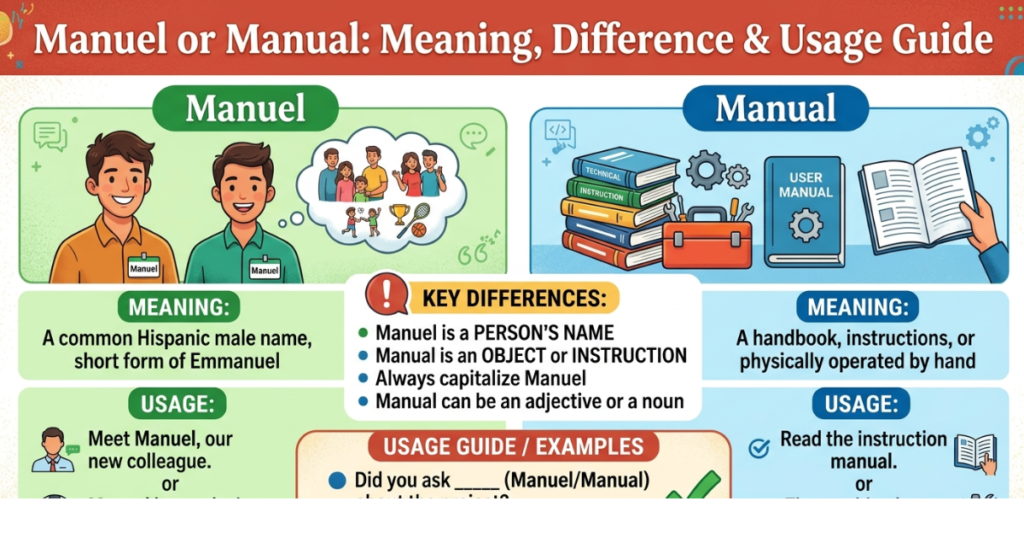
Manual vs. Manuel: The Core Difference
Let’s cut straight to it:
- Manual (with an “a”) → A common English word
- Manuel (with an “e”) → A proper name
That’s it. But let’s break it down properly so you never mix them up again.
What Does “Manual” Mean?
Definition of Manual
Manual is an English word with multiple meanings depending on context.
Common Meanings of Manual
- Instruction Guide
- A book that explains how something works
- Example: Read the user manual before using the device.
- Done by Hand (Not Automatic)
- Refers to physical or human effort
- Example: This machine requires manual operation.
- Related to Physical Work
- Often used in phrases like “manual labor”
- Example: He works in manual labor.
What Does “Manuel” Mean?
Definition of Manuel
Manuel is a male given name, commonly used in Spanish, Portuguese, and German-speaking regions.
Where You’ll See “Manuel”
- As a person’s name
- In literature, sports, or public figures
- Example: Manuel is joining us for dinner.
Important: You should never use “Manuel” unless you are referring to a person’s name.
Why People Confuse Manuel and Manual
Common Reasons for the Mistake
This error happens more often than it should. Here’s why:
- Spelling similarity (only one letter difference)
- Autocorrect errors
- Non-native English confusion
- Typing too fast without proofreading
- Real-World Example of the Mistake
Incorrect: Check the Manuel before installing the software.
Correct: Check the manual before installing the software.
How to Remember the Difference
Simple Memory Tricks
Use these quick tricks so you never mix them up again:
- Manual = A for “Action” or “Instructions”
- Manuel = E for “Entity” (a person)
Or even simpler:
If you’re not talking about a person, it’s almost always manual.
Correct Usage in Sentences
Examples You Can Copy
Using “Manual”
- The training manual is very detailed.
- This car has a manual transmission.
- Manual work can be physically demanding.
Using “Manuel”
- Manuel is a talented musician.
- I met Manuel at the conference.
When This Mistake Matters (More Than You Think)
Why Accuracy Is Important
Mixing up Manuel or Manual isn’t just a small typo—it can hurt:
- Professional credibility
- Academic grades
- SEO rankings (for content writers)
- User trust in business communication
Search engines and readers both notice sloppy writing.
FAQs About Manuel or Manual
Frequently Asked Questions
Q1: Is “Manuel” ever correct in English writing?
Yes, but only when it’s a person’s name.
Q2: Is “manual” always related to instructions?
No. It can also mean “done by hand” or refer to physical work.
Q3: Why does autocorrect change “manual” to “Manuel”?
Because “Manuel” is a recognized proper name in many languages.
Q4: Which one is more commonly used?
“Manual” is far more common in everyday English.
Q5: Can using the wrong one affect SEO?
Yes. Incorrect keywords can hurt rankings and readability.
Conclusion
Here’s the bottom line: “Manual” is a word; “Manuel” is a name. Mixing them up is easy—but fixing it is even easier once you understand the difference.
If you write anything—emails, blogs, assignments—you need to get this right. It’s a small detail that separates careless writing from sharp, professional communication.