English is full of words that sound alike but mean completely different things, and few examples confuse learners more than wear vs were vs we’re vs where. These four words are pronounced similarly in many accents, yet each serves a completely different grammatical purpose.
Because they are homophones or near-homophones, they often create spelling mistakes in emails, essays, social media posts, and even professional writing. The good news is that once you understand the meaning and role of each word, distinguishing them becomes much easier. This guide explains their definitions, grammar usage, pronunciation differences, and common mistakes in a simple, conversational way.
Why These Words Are So Confusing
The confusion mainly happens because the words sound very similar when spoken quickly.
Here’s what makes them tricky:
- Similar pronunciation
- Nearly identical spelling patterns
- Fast typing habits
- Autocorrect mistakes
- Informal online communication
Even native English speakers occasionally mix them up, especially in casual writing.
What Does “Wear” Mean?
“Wear” is usually a verb connected to clothing, appearance, or gradual damage.
Common Meanings of Wear
- To have clothing or accessories on your body
- To damage something through repeated use
- To display a facial expression
Examples of Wear
- I wear glasses every day.
- She wore a blue jacket.
- The tires began to wear out.
- He wore a confident smile.
The word usually relates to use, clothing, or physical condition.
What Does “Were” Mean?
“Were” is a past tense form of the verb “to be.”
It is commonly used with:
- You
- We
- They
- Plural subjects
It also appears in hypothetical grammar structures.
Examples of Were
- They were late to the meeting.
- We were excited about the trip.
- If I were taller, I’d play basketball.
In grammar, “were” often refers to past situations or unreal conditions.
What Does “We’re” Mean?
“We’re” is a contraction.
It combines:
- We + are
The apostrophe replaces the missing letter “a.”
Examples of We’re
- We’re going to the park.
- We’re happy to help.
- We’re watching a movie tonight.
If you can replace the word with “we are,” then “we’re” is correct.
What Does “Where” Mean?
“Where” usually refers to location, place, or position.
It often introduces questions or clauses about location.
Examples of Where
- Where do you live?
- I know where she works.
- Where is my phone?
- This is the house where I grew up.
The word focuses on place or direction.
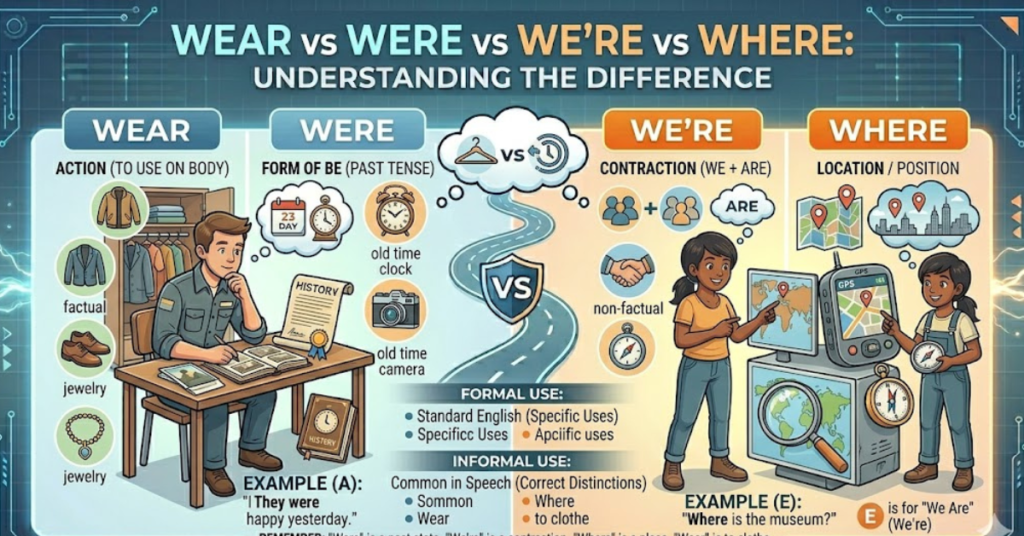
Wear vs Were vs We’re vs Where Meaning Explained
Understanding the core idea behind each word makes them easier to remember.
Wear
- Related to clothing or damage
Were
- Past tense of “to be”
We’re
- Short form of “we are”
Where
- Refers to place or location
Although they sound alike, their meanings are completely unrelated.
Grammar Breakdown of Each Word
Grammar plays a major role in distinguishing these terms.
Wear as a Verb
Examples:
- I wear sneakers daily.
- She wears a uniform.
Were as a Verb
Examples:
- They were tired.
- We were busy yesterday.
We’re as a Contraction
Examples:
- We’re leaving soon.
- We’re ready now.
Where as an Adverb or Conjunction
Examples:
- Where did you go?
- This is where it happened.
Recognizing sentence structure often reveals the correct choice instantly.
Common Mistakes People Make
Because pronunciation overlaps heavily, spelling mistakes happen often.
Incorrect
- Were going shopping.
- Where my shoes today.
- We’re is the restaurant?
- I wear at home yesterday.
Correct
- We’re going shopping.
- Wear my shoes today.
- Where is the restaurant?
- I were at home yesterday.
Actually, the proper correction would be: - I was at home yesterday.
These examples show how context matters more than sound.
Easy Tricks to Remember the Difference
Simple memory devices can help avoid confusion.
Wear = Clothing
Think:
- Wear a shirt
- Wear shoes
Were = Past
Think:
- Yesterday
- Past events
We’re = We Are
Expand the contraction:
- We’re happy = We are happy
Where = Place
Think:
- Where are you?
- Where is it?
The “h” in “where” can remind you of “here.”
Wear vs Were vs We’re vs Where in Sentences
Context helps reinforce proper usage.
Wear
- I wear a jacket in winter.
Were
- They were friends in school.
We’re
- We’re planning a vacation.
Where
- Where did you buy that?
Each word serves a unique role despite sounding similar.
Why Correct Usage Matters
Using the wrong word can confuse readers instantly.
Correct grammar helps:
- Improve readability
- Strengthen professionalism
- Avoid misunderstandings
- Build writing confidence
These distinctions matter in school, work, and everyday communication.
Pronunciation Differences
Depending on accent and speaking speed, the pronunciation may vary slightly.
Wear
Often pronounced like:
- “wair”
Were
Often pronounced like:
- “wer”
We’re
Often sounds almost identical to “were.”
Where
Usually pronounced similarly to “wear” in modern English.
Because pronunciation overlaps so heavily, spelling depends mainly on meaning and grammar.
How Native Speakers Use These Words
Native speakers rely heavily on context rather than sound.
For example:
- We’re ready.
- Where are you?
- They were late.
- I wear glasses.
Even though some words sound nearly identical, the sentence meaning quickly clarifies the intended choice.
Practice Sentences
Try choosing the correct word.
- ___ going out tonight.
- I usually ___ sneakers.
- ___ did you park the car?
- They ___ excited about the concert.
Answers
- We’re
- Wear
- Where
- Were
Practicing short examples helps build confidence naturally.
FAQs
What is the difference between wear and where?
“Wear” relates to clothing or damage, while “where” refers to place or location.
Is we’re the same as were?
No. “We’re” means “we are,” while “were” is the past tense of “to be.”
How do I remember we’re?
Replace it with “we are.” If the sentence still makes sense, “we’re” is correct.
Why are these words confusing?
They sound very similar in spoken English but have different meanings and grammar roles.
Which word relates to clothing?
“Wear” relates to clothing and accessories.
Is where always about location?
Usually yes. “Where” generally refers to place, position, or direction.
Conclusion
Understanding wear vs were vs we’re vs where can dramatically improve both your grammar and writing confidence. Although the words sound alike, each has a completely different meaning and grammatical purpose. “Wear” relates to clothing or use, “were” is a past-tense verb, “we’re” means “we are,” and “where” refers to location.
The key to mastering these commonly confused words is focusing on context rather than pronunciation. Once you understand the role each word plays in a sentence, choosing the correct spelling becomes much easier.
Small grammar improvements like this can make your communication clearer, more professional, and far more polished in both casual and formal writing.