You’ve probably typed “worse case or worst case” at least once and paused, unsure which one is actually correct. It’s a common mistake—and an easy one to fix once you understand how these words work.
Here’s the truth upfront: “worst case” is correct, while “worse case” is almost always wrong.
In this article, we’ll break down why that’s the case, how to use it properly, and how to avoid embarrassing grammar slip-ups in everyday writing. If you’ve ever wondered “is it worse case or worst case scenario?”, you’re about to get a clear, no-nonsense answer.
Understanding the Difference: Worse vs Worst
Before tackling the phrase itself, you need to get one thing straight—the difference between “worse” and “worst.”
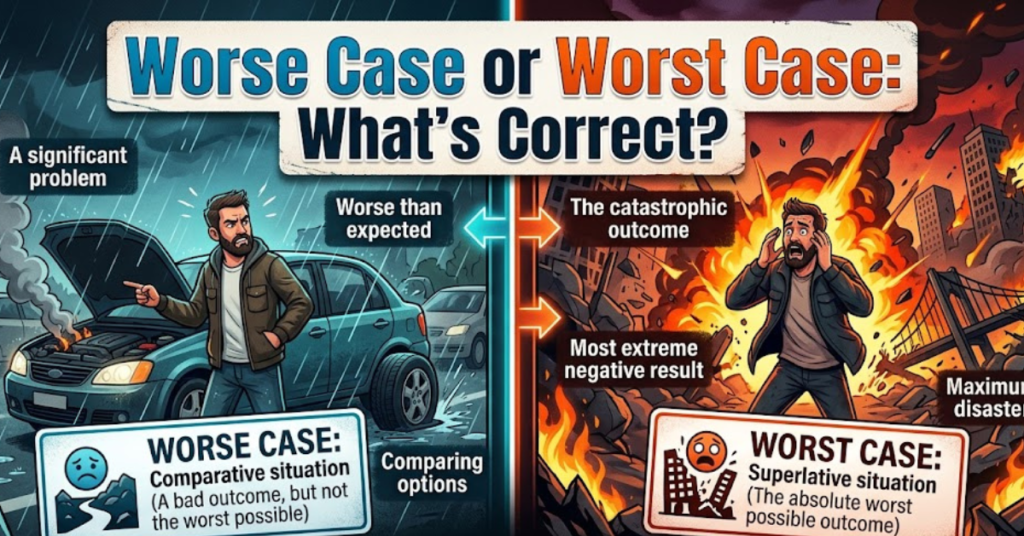
“Worse” (Comparative Form)
- Used when comparing two things
- Example:
- This plan is worse than the previous one.
“Worst” (Superlative Form)
- Used when referring to the most extreme or lowest level
- Example:
- This is the worst plan we’ve ever made.
Quick rule:
- Worse = comparing two
- Worst = the extreme
Now apply that logic to “case.”
Why “Worst Case” Is Correct
When you say “worst case”, you’re talking about the most negative possible outcome.
Correct Examples:
- Worst case, we lose some money.
- In the worst case scenario, the project fails.
- Let’s prepare for the worst case.
You’re not comparing cases—you’re describing the absolute extreme outcome. That’s why “worst” is the correct choice.
Why “Worse Case” Is Incorrect
Here’s where people mess up.
“Worse case” suggests you’re comparing one case to another, but the phrase doesn’t actually do that. It’s incomplete and grammatically off.
Incorrect Examples:
- Worse case, we fail.
- In a worse case scenario…
These sound awkward because they don’t follow proper comparative structure.
If you really wanted to use “worse,” you’d need a comparison:
- This case is worse than the last one.
But that’s not what most people mean when they talk about risk or outcomes.
“Worst Case Scenario” Explained
The full phrase “worst case scenario” is widely used in business, planning, and everyday conversation.
What it Means:
It refers to the most unfavorable outcome that could realistically happen.
Examples:
- In the worst case scenario, we miss the deadline.
- Let’s plan for the worst case scenario before moving forward.
Pro Tip:
You can often shorten it:
- “Worst case” = cleaner, faster, and just as correct
Common Mistakes and How to Fix Them
Let’s clean up the usual errors.
Mistake 1: Using “worse case”
- Worse case, we cancel the trip
- Worst case, we cancel the trip
Wrong 2: Overusing “scenario”
- Worst case scenario, we fail completely
- Worst case, we fail completely
Mistake 3: Mixing comparative and superlative
- This is the worse case possible
- This is the worst case possible
When You Can Use “Worse Case”
There’s a narrow situation where “worse case” might appear—but it’s rare and usually part of a comparison.
Example:
- This is a worse case than we expected.
Even here, it’s not the same as “worst case.” Don’t confuse the two.
Practical Tips to Get It Right Every Time
If you want to stop second-guessing yourself, follow these rules:
- If you mean the absolute worst outcome → use “worst case”
- If you’re comparing two situations → use “worse”
- When in doubt → default to “worst case”
Simple. No overthinking needed.
FAQs
1. Is it worse case or worst case?
“Worst case” is correct. “Worse case” is grammatically incorrect in almost all situations.
2. What is the correct phrase: worse case or worst case scenario?
The correct phrase is “worst case scenario.”
3. Can I just say “worst case” instead of “worst case scenario”?
Yes. In fact, “worst case” is often preferred because it’s shorter and clearer.
4. Why do people say “worse case”?
Mostly habit or misunderstanding of comparative vs superlative forms.
5. Is “worst-case” hyphenated?
Yes, when used as an adjective:
- Worst-case scenario
- This is a worst-case outcome
Conclusion
Let’s wrap it up clearly:
If you’re stuck between “worse case or worst case”, go with worst case—every time you’re talking about the most extreme outcome.
Understanding the difference between worse and worst isn’t just grammar trivia—it makes your writing sharper, clearer, and more professional.