You’ve probably seen or used the phrase “well noted” in emails, messages, or workplace communication. It sounds polite, professional, and concise—but what does it actually mean, and are you using it correctly?
In this guide, we’ll break down the well noted meaning, when to use it, common mistakes, and smarter alternatives. Whether you’re writing formal emails or casual replies, understanding this phrase will instantly sharpen your communication.
What Does “Well Noted” Mean?
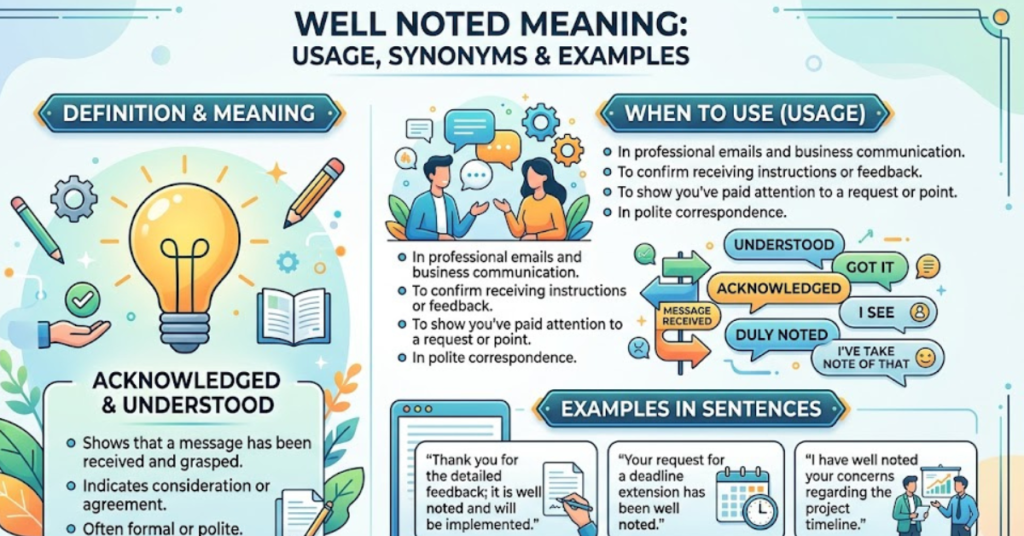
The phrase “well noted” simply means:
“I have received and understood your message.”
It’s commonly used in professional or business communication to acknowledge information without adding further comments.
Key Points:
- Shows acknowledgment
- Implies understanding
- Often used in formal contexts
For example:
“Your feedback has been well noted.”
When to Use “Well Noted”
1. In Professional Emails
“Well noted” is often used in workplace communication to confirm receipt of instructions, updates, or feedback.
Example:
- “Well noted. I will proceed accordingly.”
2. When You Don’t Need to Add More
If no further discussion is required, this phrase helps keep things short and clear.
3. In Formal Communication
It works best in structured environments like:
- Corporate emails
- Client communication
- Project updates
When NOT to Use “Well Noted”
Let’s be honest—this phrase can sound cold or robotic if misused.
Avoid it when:
- You want to sound friendly or warm
- You’re speaking casually
- A response or action is expected
Bad Example:
“Well noted.” (after someone shares bad news)
This can feel dismissive.
Well Noted Meaning in Different Contexts
The tone of “well noted” depends heavily on context.
Positive Tone:
- Acknowledging instructions
- Confirming updates
Neutral Tone:
- Passive acknowledgment without engagement
Negative Tone:
- Can sound dismissive or uninterested if used alone
Well Noted Synonyms (Better Alternatives)
Using the same phrase repeatedly makes your communication dull. Here are some well noted synonyms that sound more natural:
Formal Alternatives:
- Acknowledged
- Duly note
- Note with thanks
- Received with thanks
Friendly Alternatives:
- Got it, thanks!
- Understood
- Thanks for the update
Professional Yet Warm:
- Thanks, I’ve note this
- I understand, thank you
- This has been note, appreciate it
“Well Note With Thanks” – Is It Better?
Yes—“well note with thanks” is a stronger and more polite version.
Why it works:
- Adds appreciation
- Sounds less robotic
- Feels more human
Example:
“Well noted with thanks. I’ll take care of it.”
Common Mistakes to Avoid
1. Using It Alone
Just saying “well note” can feel abrupt.
Better:
- “Well noted, thank you.”
- “Well noted. I’ll follow up shortly.”
2. Overusing It
Repeating the phrase makes your writing sound lazy.
3. Using It in Casual Chats
It can come off as overly formal or even passive-aggressive.
Quick Usage Guide
Use “Well Note” When:
- You want to acknowledge information
- You’re in a formal setting
- No further explanation is needed
Avoid It When:
- Emotion or empathy is required
- Casual tone is preferred
- You need to continue the conversation
FAQs About “Well Noted”
1. What does “well noted mean” in simple terms?
It means you’ve received and understood the information.
2. Is “well noted” polite?
Yes, but it can sound cold if used without warmth or context.
3. Can I use “well noted” in emails?
Absolutely. It’s widely used in professional emails.
4. What is a better phrase than “well noted”?
“Thanks, I’ve noted this” or “Understood, thank you” are better in most cases.
5. Is “well noted with thanks” correct?
Yes, it’s more polite and widely accepted in business communication.
Conclusion
The phrase “well noted” is simple, but using it blindly can make you sound stiff or disengaged. Now that you understand the well noted meaning, its correct usage, and smarter alternatives, you can communicate more effectively.
Here’s the bottom line:
- Use it in formal situations
- Add warmth when needed
- Switch it up with better synonyms