You’ve probably written or read the phrase “I hope all is well” countless times—but have you ever stopped to think about its real purpose? The hope all is well meaning goes beyond simple politeness. It’s a subtle social tool used in emails, messages, and professional communication to establish tone and connection.
In this guide, you’ll learn what “I hope all is well” actually means, when to use it (and when to avoid it), plus smarter alternatives that sound more natural and less generic.
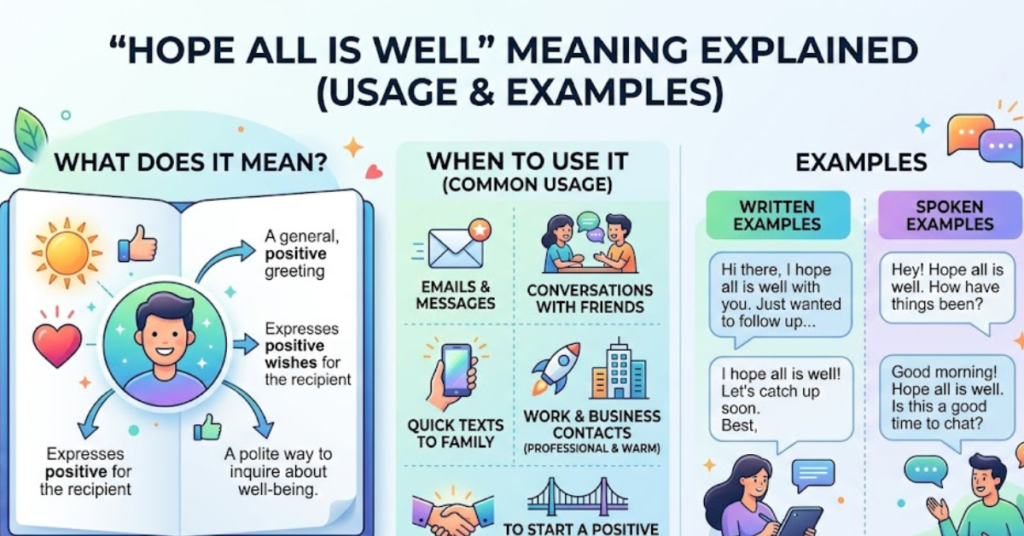
What Does “Hope All Is Well” Mean?
At its core, the hope all is well meaning is straightforward:
It’s a polite way of expressing goodwill and checking in on someone’s general well-being.
However, in real-world communication, it’s often less about genuine concern and more about:
- Starting a conversation politely
- Softening the tone of a message
- Creating a friendly or professional opening
Think of it as a verbal handshake before getting to the main point.
Why Do People Use “I Hope All Is Well”?
1. It Sets a Positive Tone
Opening with “I hope all is well” immediately makes your message sound polite and respectful.
2. It Feels Safe and Neutral
It works in almost any context—formal emails, business communication, or casual outreach.
3. It Shows Basic Courtesy
Even if it’s routine, it signals that you acknowledge the other person as more than just a task or transaction.
When Should You Use It?
The hope all is well meaning becomes more relevant depending on context. Use it when:
You’re Writing Professional Emails
- Reaching out to clients
- Following up with colleagues
- Contacting someone after a long time
You Don’t Know the Person Well
It helps maintain a polite, neutral tone without sounding too personal.
You Need a Soft Opening
Especially useful before making a request or asking for help.
When You Should Avoid It
Let’s be honest—this phrase is overused. In some cases, it can feel lazy or insincere.
Avoid it when:
- You’re writing to someone frequently (it becomes repetitive)
- The situation is urgent (get straight to the point)
- You want to sound more personal or engaging
Better Alternatives to “Hope All Is Well”
If you want to stand out, stop relying on the same phrase. Try these instead:
More Personal Options
- “I hope you’ve been doing well lately.”
- “How have you been?”
- “I hope your week is going great.”
More Specific Options
- “I hope your recent project went smoothly.”
- “I hope things are going well on your end this week.”
Straightforward Professional Openings
- “I’m reaching out regarding…”
- “I wanted to follow up on…”
Tip: The more specific you are, the more genuine you sound.
Is “I Hope All Is Well” Too Generic?
Short answer: Yes, often.
The phrase has become a default opening, especially in emails. While it’s not wrong, it can:
- Sound robotic
- Lack authenticity
- Blend in with every other message
That doesn’t mean you should never use it—but don’t rely on it as your only option.
Examples of “Hope All Is Well” in Context
Formal Email Example
I hope all is well. I’m writing to follow up on our previous discussion regarding the project timeline.
Casual Message Example
Hey, hope all is well! Just wanted to check in and see how things are going.
Improved Version
Hi, I hope your week is going well. I wanted to follow up on the timeline we discussed last week.
Common Misunderstandings
It’s Always Genuine
Not necessarily—it’s often just a polite formality.
It Shows Deep Concern
It usually signals basic courtesy, not emotional involvement.
It’s Required in Emails
You can absolutely skip it and still sound professional.
FAQs
1. What is the exact “hope all is well meaning”?
It’s a polite expression used to wish someone well and start a conversation on a positive note.
2. Is “I hope all is well” formal or informal?
It’s semi-formal. It works in both professional and casual settings but is most common in emails.
3. Is it okay to stop using this phrase?
Yes. In fact, using more specific or personalized alternatives often improves communication.
4. What can I say instead of “hope all is well”?
Try:
- “I hope you’re doing well”
- “Hope your week is going great”
- “I wanted to check in regarding…”
5. Why do people say it so often?
Because it’s easy, safe, and universally acceptable—even if it’s not very original.
Conclusion
The hope all is well meaning may seem simple, but it plays a subtle role in communication. It helps set tone, build rapport, and keep interactions polite. That said, overusing it can make your messages feel generic.
If you want to stand out, be intentional. Use it when it fits—but don’t be afraid to replace it with something more specific and human.