If you’ve ever paused mid-sentence wondering whether to write affect or effect, you’re not alone. The confusion around affect vs effect is one of the most common grammar struggles—even for experienced writers.
Here’s the good news: once you understand the difference, it becomes surprisingly easy to get it right every time. In this guide, we’ll break down the affect vs effect meaning, give you clear examples, and even show you simple tricks to avoid mistakes for good.
What Does Affect vs Effect Mean?
Let’s get straight to the point.
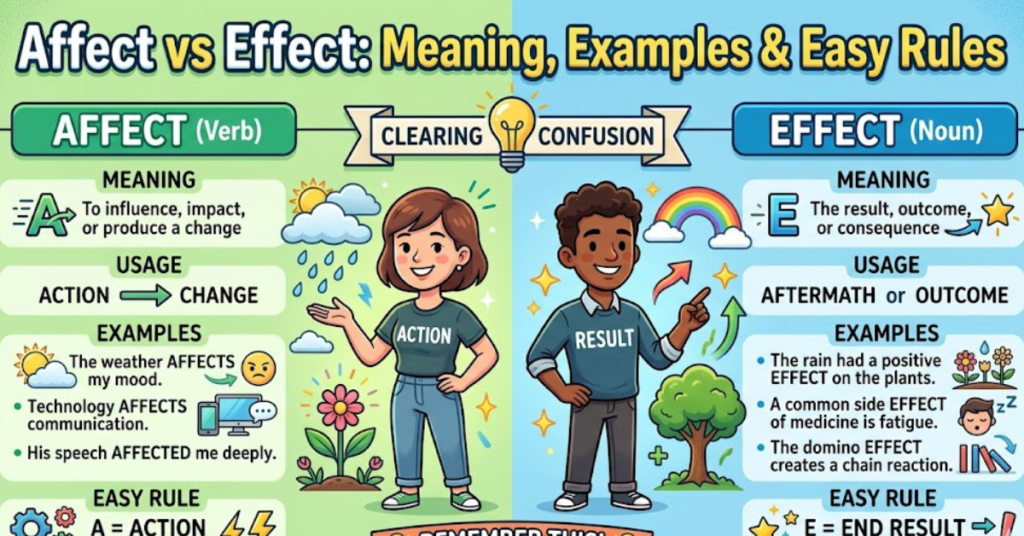
- Affect is usually a verb (an action)
- Effect is usually a noun (a result)
Simple Rule to Remember:
- Affect = Action
- Effect = End result
Affect vs Effect Example (Real-Life Usage)
Understanding through examples is where things really click.
Using Affect (Verb)
Affect means to influence or change something.
- Lack of sleep can affect your mood.
- Social media can affect how people think.
- Weather changes affect crop production.
In each case, something is influencing something else.
Using Effect (Noun)
Effect refers to the outcome or result.
- The effect of poor sleep is fatigue.
- This medicine has a calming effect.
- The new policy had a positive effect on employees.
Here, you’re talking about the result—not the action.
Quick Memory Tricks That Actually Work
You don’t need complicated grammar rules. Use these instead:
1. The “RAVEN” Trick
- Remember
- Affect = Verb
- Effect = Noun
Simple, clean, and effective.
2. Substitute Test
Replace the word with:
- “Influence” → use affect
- “Result” → use effect
Example:
- This will influence your decision → affect
- The result was surprising → effect
When the Rules Flip (Advanced Usage)
Now here’s where people mess up—there are exceptions.
1. Effect as a Verb
Yes, effect can be a verb (rare but important).
Meaning: to bring something into existence
- The government plans to effect change.
This is formal and less common.
2. Affect as a Noun
Used mainly in psychology.
- The patient showed little emotional affect.
This refers to visible emotion.
Affect vs Effect Meaning (Deep Dive)
Let’s simplify it even further:
| Word | Part of Speech | Meaning | Example |
| Affect | Verb | To influence | Stress affects health |
| Effect | Noun | A result | Stress has an effect |
Common Mistakes You Should Avoid
Here’s where most people slip:
- “This will effect your grades”
- “This will affect your grades”
- “The affect was noticeable”
- “The effect was noticeable”
Always check: is it an action or a result?
Affect vs Effect Checker Tips
Before you finalize your writing, do a quick check:
Step-by-Step Checker:
- Identify if the word shows action or result
- Replace with “influence” or “result”
- Read the sentence aloud
- Use grammar tools (like Grammarly or Hemingway Editor)
Mini Affect vs Effect Quiz
Test yourself quickly:
1. Lack of exercise can ___ your health.
a) affect
b) effect
2. The new law had a positive ___ on society.
a) affect
b) effect
3. The manager wants to ___ change in the company.
a) affect
b) effect
Answers:
- a) affect
- b) effect
- b) effect
If you got all three right, you’re ahead of most people.
Why Affect vs Effect Matters in Writing
Using the wrong word might seem small—but it can:
- Make your writing look unprofessional
- Confuse readers
- Hurt SEO and credibility
Clear grammar builds trust. And trust keeps people reading.
FAQs About Affect vs Effect
1. What is the main difference between affect vs effect?
Affect is usually a verb meaning “to influence,” while effect is a noun meaning “a result.”
2. Can affect be a noun?
Yes, but it’s rare and mostly used in psychology to describe emotional expression.
3. Can effect be a verb?
Yes. It means “to bring about” or “to cause,” but it’s used in formal contexts.
4. How can I remember affect vs effect easily?
Use the RAVEN trick: Affect = Verb, Effect = Noun.
5. Is there an affect vs effect checker?
Yes—tools like Grammarly, ProWritingAid, and Hemingway Editor can help spot mistakes.
Conclusion
Mastering affect vs effect isn’t about memorizing complicated grammar rules—it’s about understanding one simple idea: action vs result. Once you lock that in, everything else becomes easier.
If you want to improve your writing fast, start paying attention to small details like this. They add up—and they separate average writing from strong, confident communication.
Now that you’ve got the basics down, put it into practice. Write a few sentences, test yourself, and make this distinction second nature.