You’ve probably seen people write “alot” online—and maybe you’ve used it yourself. But here’s the truth: when it comes to “alot or a lot,” only one of them is actually correct in standard English.
This article breaks down “is it alot or a lot,” explains why the confusion exists, and shows you how to avoid this common mistake in your writing. If you want your English to look polished and professional, this is something you need to fix—right now.
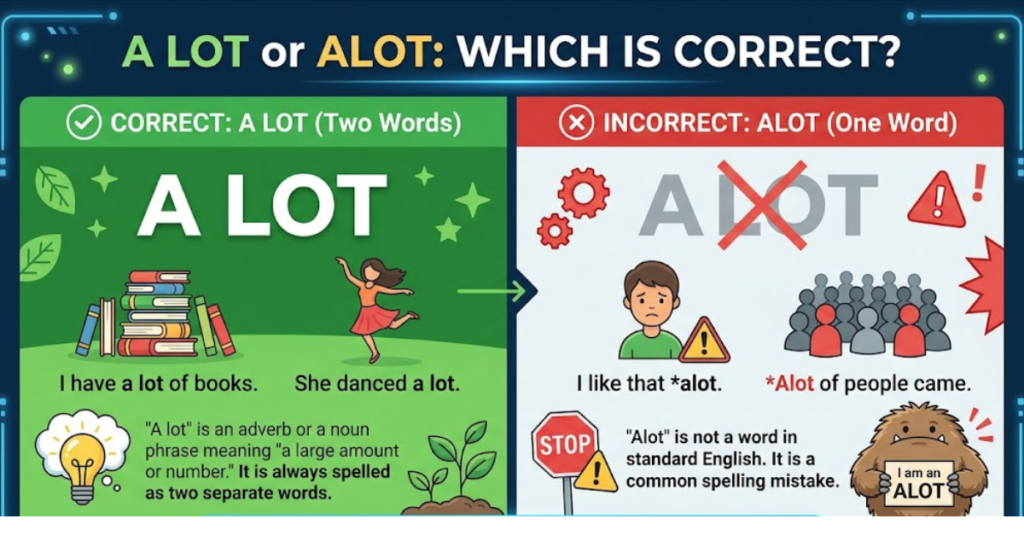
Alot or A Lot: Which Is Correct?
Let’s settle it clearly:
“A lot” is correct
“Alot” is incorrect (in standard English)
Why “A Lot” Is Correct
“A lot” is a two-word phrase that means:
- A large number
- A great amount
Examples:
- I have a lot of work today.
- She learned a lot from that experience.
Why “Alot” Is Wrong
“Alot” is not recognized as a proper word in formal English. It’s simply a common spelling mistake. While you may see it in casual texts or social media, it should be avoided in:
- Academic writing
- Professional emails
- Blogs and articles
Why Do People Confuse “Alot” and “A Lot”?
This mistake happens for a few simple reasons:
1. Similar Words Exist
Words like “almost,” “already,” and “always” are single words. So people assume “alot” follows the same pattern.
2. Fast Typing Habits
When typing quickly, people merge words without thinking.
3. Lack of Correction
Spellcheck tools sometimes miss informal usage, so the habit sticks.
Is It Alot or A Lot in Different Contexts?
No matter the context, the rule stays the same:
Correct: a lot
Incorrect: alot
Common Phrases
Here’s where people often get it wrong:
- Thanks alot
- Thanks a lot
- I like it alot
- I like it a lot
“Thanks Alot or A Lot”: What’s Right?
This is one of the most searched variations: “thanks alot or a lot.”
The correct version is: “Thanks a lot.”
It’s used to express gratitude or appreciation.
Examples:
- Thanks a lot for your help.
- I appreciate it a lot.
Easy Trick to Remember the Difference
Here’s a simple way to lock it in your brain:
If you can replace it with “a large amount,” then use “a lot.”
Example:
- I have a lot of homework → I have a large amount of homework
That substitution works perfectly—so “a lot” is the right choice.
Common Mistakes to Avoid
If you want clean, professional writing, avoid these:
- Writing “alot” in formal content
- Mixing informal habits with academic writing
- Assuming “alot” is acceptable because others use it
Quick Fix Checklist:
- Always separate into two words: a + lot
- Double-check before publishing
- Use grammar tools if needed
Related Words You Should Know (LSI Keywords)
Understanding related terms helps reinforce correct usage:
- Plenty
- A great deal
- A large number
- Many / much
These can sometimes replace “a lot” to improve writing variety.
FAQs About “Alot or A Lot”
1. Is “alot” ever correct?
No. “Alot” is not correct in standard English. Always use “a lot.”
2. Why do people still write “alot”?
Mostly habit, fast typing, or lack of awareness.
3. Is “a lot” formal or informal?
It’s acceptable in both, but in formal writing, alternatives like “many” or “numerous” may sound more polished.
4. Can I use “alot” in casual texting?
You can—but it’s still technically incorrect. Better to build the right habit.
5. What about “allot”?
Good catch—“allot” is a real word, but it means to distribute or assign (e.g., allot time or resources). It’s completely different from “a lot.”
Conclusion
Let’s not overcomplicate it: when deciding between “alot or a lot,” the answer is always “a lot.”
It’s a small detail, but it makes a big difference in how your writing is perceived. Clean grammar signals clarity, credibility, and attention to detail.