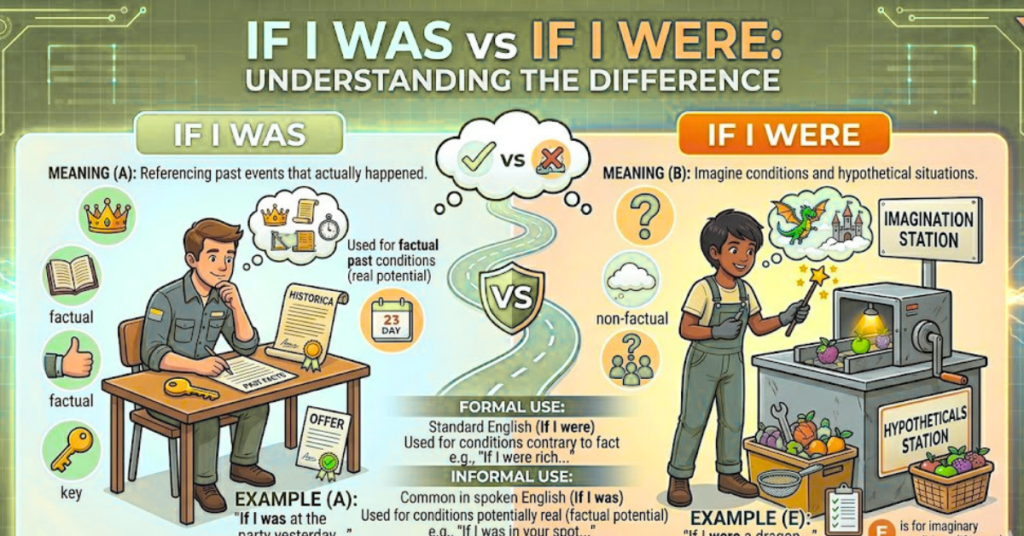
English grammar can be surprisingly tricky, especially when two phrases sound almost identical but follow different rules. One of the most common grammar questions people ask is about if I was vs if I were. Both phrases appear regularly in conversation, books, songs, and movies, which makes the confusion even more understandable.
The key difference comes down to whether you’re talking about something real or imaginary. While modern English sometimes uses both casually, traditional grammar rules still distinguish between them. This guide breaks down the meanings, grammar rules, examples, and practical usage of each phrase in a simple and easy-to-understand way.
What Does “If I Was” Mean?
“If I was” is generally used when talking about something that actually happened or might realistically have happened.
It refers to:
- Real situations
- Possible events
- Past facts or uncertainty about facts
Examples of “If I Was”
- If I was rude yesterday, I apologize.
- If I was at the meeting, I don’t remember it.
- Call me if I was mistaken.
In these examples, the speaker refers to situations that could realistically be true.
What Does “If I Were” Mean?
“If I were” is usually used for hypothetical, imaginary, or unreal situations.
This structure uses the subjunctive mood, which English grammar applies to situations that are:
- Unreal
- Impossible
- Imagined
- Contrary to fact
Examples of “If I Were”
- If I were rich, I would travel the world.
- If I were you, I’d take the job.
- If I were taller, I’d play basketball professionally.
These examples describe situations that are imagined rather than factual.
If I Was vs If I Were Grammar Rules
Understanding if I was vs if I were grammar becomes easier when you focus on one simple question:
Is the situation real or hypothetical?
Use “If I Was” For Real Possibilities
Use it when:
- Something may have happened
- A situation could be true
- The speaker is uncertain about reality
Example:
- If I was unclear earlier, let me explain again.
Use “If I Were” For Imaginary Situations
Use it when:
- The situation is unreal
- The speaker imagines something different from reality
- Giving advice hypothetically
Example:
- If I were the manager, I would change the policy.
Understanding the Subjunctive Mood
The phrase “if I were” comes from a grammar structure called the subjunctive mood.
What Is the Subjunctive Mood?
The subjunctive expresses:
- Wishes
- Hypothetical situations
- Imaginary ideas
- Suggestions or demands
In modern English, it mainly survives in phrases like:
- If I were
- I wish I were
- As if he were
Although casual conversation sometimes replaces “were” with “was,” formal grammar still prefers “were” for hypothetical statements.
Why People Say “If I Was” So Often
In everyday speech, many native speakers use “if I was” even in hypothetical situations.
Reasons Include
- Simpler conversational English
- Regional dialects
- Informal speech habits
- Natural language evolution
For example, people often say:
- If I was you…
Even though traditional grammar prefers:
- If I were you…
In casual conversation, both are widely understood.
If I Was vs If I Were Difference Explained Simply
A quick comparison makes the distinction clearer.
“If I Was”
- Refers to reality or possible facts
- Indicates uncertainty about something real
Example:
- If I was late, traffic caused it.
“If I Were”
- Refers to imaginary or impossible situations
- Used for dreams, wishes, or advice
Example:
- If I were famous, life would be different.
The difference mainly depends on whether the statement reflects reality.
Common Expressions Using “If I Were”
Some English phrases almost always use “were.”
Popular Examples
- If I were you
- I wish I were there
- As if I were invisible
- If I were in charge
These expressions sound more natural with the subjunctive form.
Situations Where “If I Was” Is Correct
Many people assume “if I was” is always wrong, but that isn’t true.
Correct Examples
- If I was included in the email, please resend it.
- If I was responsible for the error, I apologize.
- If I was there, I honestly don’t remember.
These situations involve uncertainty about real events.
Formal vs Informal Usage
Grammar standards vary depending on context.
Formal Writing
Academic and professional writing usually follows traditional rules:
- Hypothetical = “were”
- Real possibility = “was”
Casual Conversation
Everyday speech is more flexible, and many native speakers use “was” in both cases.
Understanding the difference helps you adapt your language to different settings.
Grammar Experts and Modern Usage
Many grammar authorities acknowledge that everyday English has become more flexible.
Even so, formal grammar guides still recommend:
- “If I were” for hypothetical situations
This recommendation remains common in:
- Academic writing
- Journalism
- Professional communication
Easy Memory Trick
A simple trick can help you remember which phrase to use.
“Were” = Wish or Unreal Situation
Think:
- If I were a millionaire…
Clearly imaginary.
“Was” = Possible Reality
Think:
- If I was rude earlier…
That could actually be true.
This distinction works in most situations.
Common Mistakes to Avoid
Incorrect in Formal Grammar
- If I was you, I’d apologize.
Preferred Formal Version
- If I were you, I’d apologize.
Correct Use of “Was”
- If I was wrong, I’ll fix it.
The second example deals with a possible real mistake.
FAQs
Which is correct: if I was or if I were?
Both can be correct depending on context. “If I were” is preferred for hypothetical situations, while “if I was” refers to possible real situations.
Why do people say “if I was you”?
Casual spoken English often ignores traditional subjunctive grammar rules.
Is “if I were” old-fashioned?
No. It is still widely used in formal English and professional writing.
What is the subjunctive mood?
The subjunctive mood expresses imaginary, hypothetical, or wished-for situations.
Is “if I was” grammatically wrong?
Not always. It is correct when referring to something that may actually have happened.
Which form should I use in professional writing?
Use “if I were” for hypothetical situations in formal or academic writing.
Conclusion
Understanding the difference between if I was vs if I were can dramatically improve your grammar confidence and writing clarity. Although the phrases sound similar, they serve different purposes in English. “If I was” generally relates to real or possible situations, while “if I were” belongs to hypothetical or imaginary scenarios.
Modern conversation often blends the two forms, but knowing the traditional grammar rule helps you communicate more effectively in formal settings. Once you recognize whether a sentence describes reality or imagination, choosing the correct phrase becomes much easier.
Mastering small grammar distinctions like this strengthens both spoken and written communication, making your English sound more polished, natural, and accurate.