If you’ve ever paused mid-sentence wondering whether it’s definitely or definitely—you’re not alone. This is one of the most commonly misspelled words in English, and it catches even confident writers off guard.
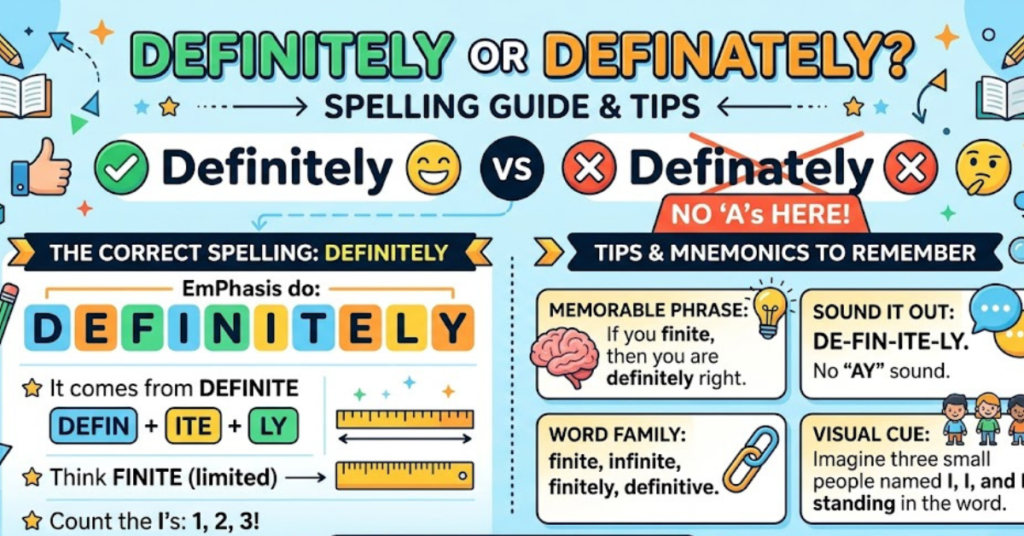
Here’s the short answer: “definitely” is the correct spelling.
In this article, we’ll break down why people get it wrong, how to remember the correct version, and how to use it naturally in everyday writing. By the end, you won’t second-guess it again.
What Does “Definitely” Mean?
Definitely is an adverb that means:
- Without doubt
- Clearly or certainly
- In a way that leaves no room for confusion
Examples:
- I will definitely call you tomorrow.
- That was definitely the best meal I’ve had this week.
- She is definitely qualified for the job.
It adds certainty and confidence to your sentence.
Why Do People Misspell “Definitely”?
The most common mistake is spelling it as “definately.”
Here’s why that happens:
- People pronounce it incorrectly (“def-in-it-ly” becomes “def-in-ate-ly”)
- Confusion with similar-sounding words like “separate”
- Typing quickly without checking
Your brain hears one thing and your fingers type another. Simple as that.
The Trick to Remember the Correct Spelling
Here’s a practical way to lock it in:
Break it into parts:
Definite + ly = definitely
If you can spell “definite”, just add -ly.
Quick memory hack:
“It is finite, not finate — so it’s definitely, not definately.”
That small shift helps your brain anchor the correct version.
Definitely vs. Definately: Key Differences
| Word | Correct? | Meaning |
| Definitely | Yes | Without doubt |
| Definately | No | Misspelling |
There’s no gray area here—“definately” is always incorrect.
Common Mistakes to Avoid
Even if you know the correct spelling, these traps can still catch you:
1. Relying on autocorrect
Autocorrect won’t always save you—especially if you’ve used the wrong spelling repeatedly.
2. Typing too fast
Speed kills accuracy. Slow down slightly when writing important content.
3. Skipping proofreading
A quick reread can catch this instantly.
How to Use “Definitely” Naturally
Using the word correctly is just as important as spelling it right.
In conversations:
- “I’ll definitely be there.”
- “That’s definitely worth trying.”
In professional writing:
- “This strategy will definitely improve results.”
- “The data definitely supports this conclusion.”
Tip:
Don’t overuse it. Too many “definitelys” can weaken your tone.
Synonyms for “Definitely”
To keep your writing fresh, try these alternatives:
- Certainly
- Absolutely
- Clearly
- Undoubtedly
- For sure
Example:
Instead of:
“I will definitely attend the meeting.”
Try:
“I will certainly attend the meeting.”
SEO Tip: Why “Definitely or Definitely” Gets So Many Searches
People often search for “definitely or definitely” because they’re unsure of spelling, not meaning. It’s a classic confusion query—high volume, low clarity.
Related search terms (LSI keywords):
- how to spell definitely
- definitely meaning
- definitely vs definately
- common spelling mistakes in English
Using these naturally in your content improves SEO without stuffing keywords.
FAQs About “Definitely or Definitely”
1. Is “definately” ever correct?
No. It’s always a misspelling. The correct form is definitely.
2. Why is “definitely” so hard to spell?
Because pronunciation doesn’t clearly match the spelling, and people often mishear the “finite” part.
3. What’s the easiest way to remember it?
Think: definite + ly. If you can spell “definite,” you’re good.
4. Can I use “definitely” in formal writing?
Yes. It’s perfectly acceptable in both formal and informal contexts.
5. Are there tools to check spelling automatically?
Yes—tools like Grammarly or built-in spell checkers can help, but don’t rely on them blindly.
Conclusion
Here’s the bottom line: when it comes to definitely or definitely, there’s only one correct answer—and that’s definitely.
It’s a small detail, but getting it right instantly makes your writing look sharper and more professional. Use the “definite + ly” trick, slow down when typing, and proofread your work.