English comparison words can be confusing, especially when both options sound correct in everyday speech. One common question learners ask is about cleverer vs more clever. Should we say “she is cleverer than him” or “she is more clever than him”?
The short answer: both are grammatically correct, but one is generally preferred in modern English. Understanding why requires a closer look at grammar rules, style, and natural usage.
This guide breaks everything down in a simple, practical way so you can confidently use the right form in speaking and writing.
What Does “Clever” Mean?
Before comparing forms, it helps to understand the base adjective.
The word “clever” means:
- Intelligent
- Quick-witted
- Smart in thinking or problem-solving
Example:
- She is a clever student who solves problems quickly.
Now let’s see how it changes in comparison form.
Understanding Comparative Adjectives in English
Comparative adjectives are used to compare two people, places, or things.
There are two main ways to form comparatives:
1. Adding “-er”
Used for shorter adjectives.
Examples:
- smart → smarter
- fast → faster
- clever → cleverer
2. Using “more”
Used for longer adjectives.
Examples:
- beautiful → more beautiful
- intelligent → more intelligent
- careful → more careful
But “clever” sits in a gray area, which is where the confusion starts.
Cleverer vs More Clever: The Grammar Rule
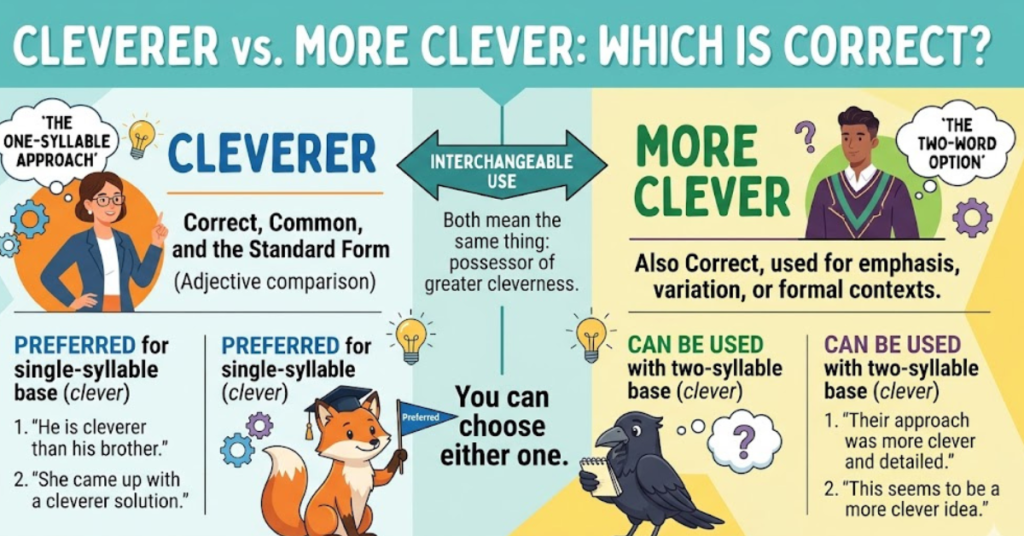
Both cleverer vs more clever are grammatically acceptable, but they follow different usage preferences.
Cleverer
“Cleverer” follows the standard comparative rule for short adjectives.
Example:
- She is cleverer than her brother.
This form is:
- More traditional
- Common in British English
- Shorter and more direct
More Clever
“More clever” uses the “more + adjective” structure.
Example:
- She is more clever than her brother.
This form is:
- Slightly more formal or stylistic
- Often used in American English
- Sometimes preferred for emphasis or clarity
Which One Is More Natural?
In modern English usage, “cleverer” is generally more common, especially in spoken British English.
However, “more clever” is not incorrect. It often appears in:
- Formal writing
- Academic contexts
- Emphatic or stylistic sentences
So instead of asking which is correct, it’s better to ask which sounds more natural in context.
Cleverer vs More Clever in Real Examples
Let’s compare both in practical sentences.
Using “Cleverer”
- He is cleverer than he looks.
- My dog is cleverer than most animals.
- She became cleverer after practice.
Using “More Clever”
- He is more clever than he looks.
- This solution is more clever than the first one.
- She seems more clever under pressure.
Both are understandable, but the tone changes slightly.
Style Differences in British and American English
Language preference often depends on region.
British English
- Prefers “cleverer”
- Favors shorter comparative forms
- Sounds more natural in everyday speech
American English
- Uses both forms
- Often leans toward “more clever” in formal writing
- Focuses more on clarity than structure rules
This means neither form is “wrong”—it’s about usage style.
When Should You Use Cleverer?
Use cleverer when:
- Writing casual or conversational English
- Speaking naturally
- Following traditional grammar patterns
- You want a smoother, shorter expression
Example:
- She is cleverer than her classmates.
When Should You Use More Clever?
Use more clever when:
- Writing formal essays
- Emphasizing comparison
- Avoiding awkward sounding repetition
- Matching a formal tone
Example:
- This strategy is more clever than the previous one.
Common Mistakes Learners Make
Here are a few errors people often make:
1. Overthinking correctness
Both forms are correct, so don’t stress about choosing only one.
2. Mixing structures
Incorrect:
- She is more cleverer than him.
Correct:
- She is cleverer than him.
OR - She is more clever than him.
3. Ignoring context
Tone matters more than strict rules in modern English.
Quick Memory Trick
To remember easily:
- Short adjective → “-er” form (cleverer)
- Formal tone → “more + adjective” (more clever)
If both sound fine in your sentence, “cleverer” is usually the safer everyday choice.
FAQs
Is cleverer correct grammar?
Yes, “cleverer” is grammatically correct and widely used, especially in British English.
Is more clever wrong?
No, “more clever” is also correct, but slightly less common in casual speech.
Which is better: cleverer vs more clever?
Neither is strictly better. “Cleverer” is more natural in everyday English, while “more clever” can sound more formal.
Why do both forms exist?
Because English allows two comparative structures: “-er” endings for short adjectives and “more + adjective” for longer or stylistically flexible words.
Can I use both in writing?
Yes, but consistency is important. Choose one style within the same piece of writing.
Conclusion
The comparison of cleverer vs more clever shows something important about English: it is flexible, not rigid. Both forms are correct, but they serve slightly different tones and contexts.
If you want a natural, everyday expression, “cleverer” is usually the best choice. If you’re aiming for formality or emphasis, “more clever” works just as well.
The key takeaway is simple: focus less on strict rules and more on clarity and tone. Once you understand how comparative adjectives work, choosing the right form becomes second nature.