English can feel tricky sometimes, especially when small word parts completely change a word’s meaning. That’s exactly what happens with prefixes. If you’ve ever wondered how words like “disagree” and “misunderstand” are formed, understanding dis and mis prefixes is the key.
These two prefixes appear in thousands of English words, and although they may look similar, they have very different meanings. Learning how they work can improve your vocabulary, spelling, reading comprehension, and writing skills. Whether you’re a student, language learner, or simply trying to sharpen your grammar, this guide breaks everything down in a simple and practical way.
What Are Prefixes in English?
A prefix is a group of letters added to the beginning of a word to change its meaning. Prefixes do not usually stand alone. Instead, they attach to root words and create new words.
For example:
- Happy → Unhappy
- Legal → Illegal
- Agree → Disagree
Prefixes are important because they help readers quickly understand unfamiliar words.
Among the most commonly used prefixes in English are “dis-” and “mis-.”
Understanding the Dis Prefix
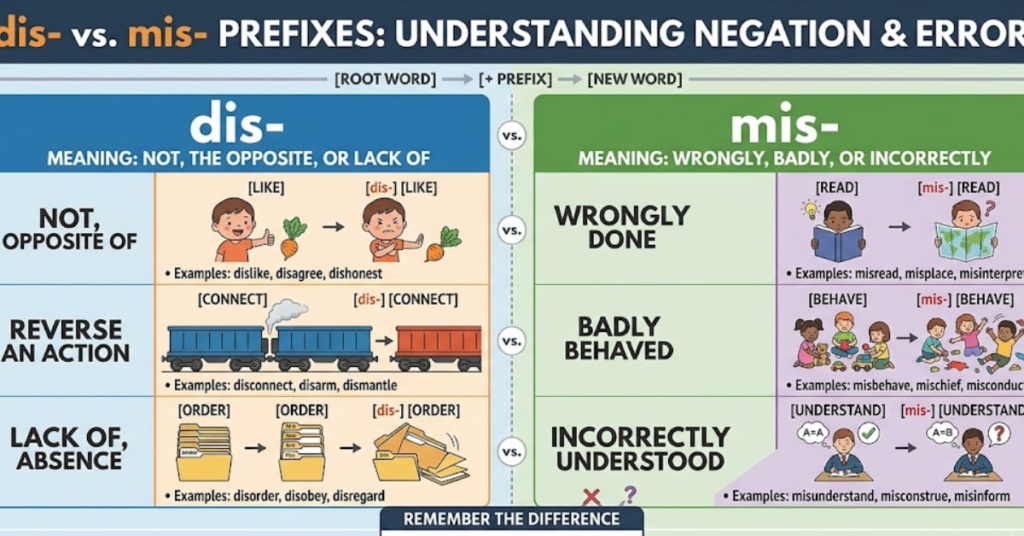
The prefix “dis-” usually means:
- Not
- Opposite of
- Away from
- Reverse of
When added to a word, it often creates a negative or opposite meaning.
Common Words With the Dis Prefix
Here are some everyday examples:
- Disagree – to not agree
- Disconnect – to separate
- Disappear – to go away
- Dislike – to not like
- Disrespect – lack of respect
You can often spot the negative meaning immediately once you recognize the prefix.
Examples in Sentences
- I disagree with that opinion.
- Please disconnect the charger before cleaning the device.
- The magician made the coin disappear.
These examples show how the prefix changes the meaning of the base word completely.
Understanding the Mis Prefix
The prefix “mis-” usually means:
- Wrongly
- Badly
- Incorrectly
It often describes mistakes, errors, or misunderstandings.
Common Words With the Mis Prefix
Some common examples include:
- Misunderstand – to understand incorrectly
- Misplace – to put in the wrong location
- Misbehave – to behave badly
- Mislead – to guide someone incorrectly
- Misspell – to spell wrongly
Unlike “dis-,” which often creates an opposite meaning, “mis-” usually suggests something was done incorrectly.
Examples in Sentences
- I misunderstood the instructions.
- She misplaced her keys again.
- The advertisement misled customers.
These words focus more on errors rather than opposites.
Dis and Mis Prefixes: Key Differences
Although both prefixes change meanings, they work differently.
The “Dis-” Prefix
“Dis-” generally creates a negative or opposite meaning.
Examples:
- Honest → Dishonest
- Connect → Disconnect
- Like → Dislike
The “Mis-” Prefix
“Mis-” refers to mistakes or incorrect actions.
Examples:
- Understand → Misunderstand
- Judge → Misjudge
- Inform → Misinform
A simple way to remember this is:
- “Dis-” often means “not” or “opposite.”
- “Mis-” usually means “wrongly.”
Why Learning Prefixes Matters
Understanding prefixes can dramatically improve your English skills. Instead of memorizing every word separately, you begin recognizing patterns.
Benefits include:
- Faster vocabulary growth
- Better reading comprehension
- Improved spelling
- Stronger writing skills
- Easier understanding of unfamiliar words
For example, if you know the meaning of “mis-,” you can often guess the meaning of words like “miscalculate” or “misinterpret” even if you’ve never seen them before.
Common Mistakes Students Make
Many learners confuse prefixes because they focus only on spelling instead of meaning.
Here are a few common mistakes:
Using “Dis-” Instead of “Mis-”
Incorrect:
- He disunderstood the lesson.
Correct:
- He misunderstood the lesson.
Why? Because the problem was incorrect understanding, not the opposite of understanding.
Assuming All Negative Words Use “Dis-”
Not every negative word uses the same prefix.
Examples:
- Impossible
- Unclear
- Inactive
English uses many different prefixes depending on the word origin and grammar rules.
Easy Tricks to Remember the Difference
Learning prefixes becomes easier with memory techniques.
Remember “Dis-” as Opposition
Think of:
- Disconnect
- Disagree
- Disapprove
These words suggest separation or opposition.
Remember “Mis-” as Mistakes
Think of:
- Misprint
- Misread
- Mishear
These words involve errors or incorrect actions.
Most Common Words With Dis and Mis Prefixes
Here are some useful words worth learning.
Popular Dis Words
- Disappear
- Disallow
- Discomfort
- Dishonest
- Disobey
- Disapprove
Popular Mis Words
- Miscommunicate
- Miscount
- Misjudge
- Mismanage
- Mispronounce
- Misread
Expanding your knowledge of these words helps you sound more natural in both speaking and writing.
How Prefixes Help With Spelling
Prefixes also improve spelling accuracy because they create recognizable patterns.
For example:
- “Dis-” usually stays consistent in spelling:
- Dislike
- Disconnect
- Disappear
- “Mis-” also keeps the same form:
- Mislead
- Misplace
- Misprint
Once you learn the pattern, spelling becomes easier and more predictable.
Are Dis and Mis Prefixes Used in Academic English?
Absolutely. These prefixes appear frequently in academic, professional, and formal writing.
Examples include:
- Misinterpretation
- Disorganization
- Misinformation
- Disapproval
Students preparing for exams or academic writing tasks benefit greatly from mastering these word forms.
Fun Practice Exercise
Try identifying whether the correct prefix is “dis-” or “mis-.”
- _____understand
- _____connect
- _____spell
- _____agree
- _____inform
Answers:
- Misunderstand
- Disconnect
- Misspell
- Disagree
- Misinform
Simple exercises like this help reinforce the meanings naturally.
How Children Learn Prefixes
Teachers often introduce prefixes during elementary school because they improve vocabulary development quickly.
Children usually learn prefixes through:
- Reading activities
- Word sorting games
- Vocabulary worksheets
- Sentence-building exercises
Once students recognize patterns, they become more confident readers.
FAQs
What do dis and mis prefixes mean?
“Dis-” usually means not, opposite, or apart, while “mis-” means wrongly or incorrectly.
What is the difference between dis and mis prefixes?
The main difference is meaning. “Dis-” creates an opposite or negative meaning, while “mis-” refers to mistakes or incorrect actions.
Is “misunderstand” spelled with dis or mis?
The correct spelling is “misunderstand” because it refers to understanding something incorrectly.
Can prefixes change the entire meaning of a word?
Yes. Prefixes can completely transform a word’s meaning. For example, “agree” becomes “disagree,” which means the opposite.
Are prefixes important for vocabulary building?
Definitely. Learning prefixes helps readers understand unfamiliar words more easily and improves overall language skills.
What are other common English prefixes?
Some popular prefixes include:
- Un-
- Re-
- Pre-
- In-
- Over-
- Under-
Each changes word meanings in different ways.
Conclusion
Understanding dis and mis prefixes can make English far less confusing. While “dis-” usually signals opposition or negation, “mis-” points to mistakes or incorrect actions. Once you learn the difference, reading, spelling, and writing become much easier.
The best way to master prefixes is through regular practice. Pay attention to how words are formed, read widely, and try using new vocabulary in daily conversations or writing. Over time, these small language patterns become second nature and strengthen your overall communication skills.