English is full of word variations that sound almost identical but spark endless grammar debates. One common example is orientated vs oriented. Many people wonder whether one spelling is incorrect, whether both are acceptable, or if regional English changes the rules.
The truth is that both words exist and both are grammatically valid. However, usage preferences vary depending on location, style guides, and professional writing standards. This guide explains the meanings, grammar, regional differences, examples, and practical usage of both terms in a clear and conversational way.
What Do “Orientated” and “Oriented” Mean?
Both words carry the same core meaning.
They generally refer to:
- Being directed toward something
- Being focused on a goal or activity
- Becoming familiar with surroundings or information
Common Examples
- customer-oriented service
- career-orientated training
- family-oriented business
- goal-orientated mindset
The meaning remains the same regardless of spelling.
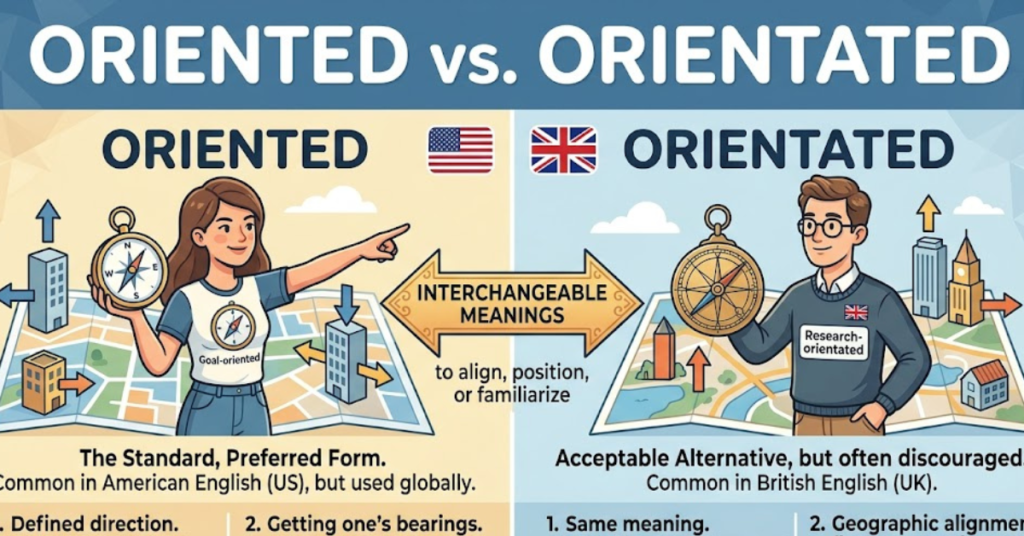
Orientated vs Oriented Meaning Explained
The phrase orientated vs oriented meaning often confuses English learners because both forms appear widely online and in professional writing.
Oriented
Usually considered the shorter and more standard form.
Orientated
A longer variation used more frequently in British English.
Both words describe focus, direction, or alignment.
Which Word Is More Common?
“Oriented” is generally more common worldwide, especially in:
- American English
- Academic writing
- Business communication
- Journalism
“Orientated” appears more often in:
- British English
- Informal UK writing
- Conversational speech
Even though both are correct, “oriented” is usually preferred in formal writing.
Orientated vs Oriented UK Usage
In the United Kingdom, both versions are widely accepted.
However:
- “Orientated” sounds more natural to many UK speakers.
- “Oriented” still appears frequently in professional contexts.
UK Examples
- family-orientated company
- career-orientated education
British English tends to tolerate both forms comfortably.
Orientated vs Oriented in American English
American English strongly favors “oriented.”
In the United States, “orientated” can sound awkward or overly wordy to some readers.
Common American Examples
- customer-oriented approach
- results-oriented leadership
- detail-oriented employee
These phrases dominate professional and workplace communication.
Family Orientated vs Oriented
This phrase is especially common in business descriptions and marketing.
Family-Oriented
More common in:
- American business writing
- Real estate listings
- Professional branding
Family-Orientated
More common in:
- British English
- Casual UK usage
Both communicate the same idea: something designed with families in mind.
Why Do Both Versions Exist?
The difference comes from language evolution.
“Orient” originally meant:
- To align
- To position
- To direct
Over time:
- “Oriented” developed naturally from the verb.
- “Orientated” emerged as an expanded variation.
English often creates multiple accepted forms of the same word.
Is Orientated vs Oriented a Grammar Issue?
Technically, no.
This is more about:
- Style preference
- Regional variation
- Usage trends
Both words appear in major dictionaries.
Still, many editors prefer “oriented” because it is shorter and more widely recognized internationally.
Define Orientated vs Oriented Simply
Here’s the simplest definition:
Oriented
Directed toward a purpose or goal.
Orientated
Exactly the same meaning, but less common in some regions.
The distinction is stylistic rather than grammatical.
Common Business Usage
These words appear frequently in professional settings.
Popular Phrases
- customer-oriented
- service-oriented
- detail-oriented
- goal-oriented
- career-orientated
- family-orientated
Professional writing usually leans toward “oriented.”
Which Version Should You Use?
The best choice depends on audience and location.
Use “Oriented” When
- Writing for international audiences
- Creating formal documents
- Following American English standards
- Writing professionally
Use “Orientated” When
- Writing for UK audiences
- Matching British English style
- Maintaining regional consistency
Consistency matters more than the specific version you choose.
Orientated vs Oriented Examples
Seeing both words in context helps clarify usage.
Oriented Examples
- The company is customer-oriented.
- She is highly career-oriented.
- Our training is results-oriented.
Orientated Examples
- The program is family-orientated.
- He has a community-orientated mindset.
- The business is service-orientated.
Both forms function naturally in sentences.
Pronunciation Differences
In many accents, pronunciation differs slightly.
Oriented
Often pronounced:
- “OR-ee-en-tid”
Orientated
Often pronounced:
- “OR-ee-en-tay-tid”
The extra syllable in “orientated” makes it longer.
Common Mistakes to Avoid
Mixing Spellings
Avoid switching between the two forms within the same article or document.
Assuming One Is Incorrect
Both words are legitimate English terms.
Ignoring Audience Expectations
International business writing typically favors “oriented.”
Why “Oriented” Is More Popular Online
Search engines, businesses, and style guides tend to prefer shorter wording.
“Oriented” is:
- Faster to read
- Easier to type
- More common globally
That widespread usage reinforces its popularity.
FAQs
Which is correct: orientated or oriented?
Both are correct English words. “Oriented” is simply more common in modern usage.
Is orientated British English?
Yes. “Orientated” appears more frequently in British English.
Is oriented American English?
Yes. American English strongly prefers “oriented.”
Which form is better for professional writing?
“Oriented” is usually preferred in formal and international communication.
Do orientated and oriented mean the same thing?
Yes. Both words describe direction, focus, or alignment.
Is family orientated grammatically correct?
Yes. “Family orientated” is correct, especially in British English.
Conclusion
Understanding orientated vs oriented becomes much easier once you realize both words are grammatically correct. The real difference lies in regional preference, writing style, and audience expectations. “Oriented” dominates American English and professional communication, while “orientated” remains common in British English and conversational usage.
For most formal writing, “oriented” is the safer and more universally accepted option. Still, if you consistently use British English conventions, “orientated” works perfectly well.
Small language distinctions like this may seem minor, but they can help your writing sound more polished, natural, and appropriate for your audience.