Confused about sheer vs shear? You’re not alone. These two words sound identical, but their meanings are completely different—and mixing them up can make your writing look sloppy.
In this guide, we’ll break down sheer vs shear in plain English, with real examples, memory tricks, and practical usage tips so you never get them wrong again.
Understanding the Basics of Sheer vs Shear
Let’s start with the simplest explanation.
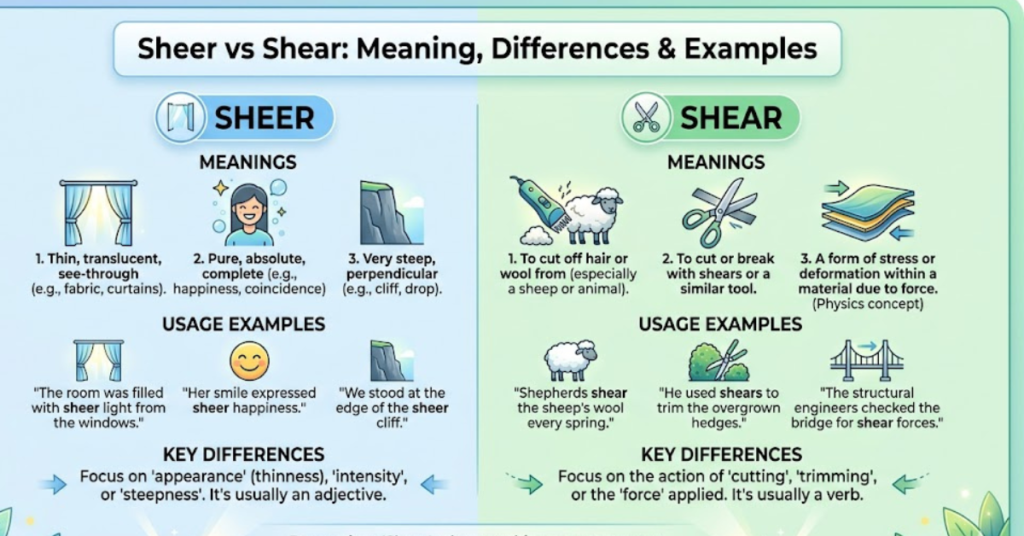
- Sheer = extreme, thin, or complete
- Shear = to cut, trim, or a force that causes layers to slide
Same pronunciation. Totally different meanings.
What Does “Sheer” Mean?
The word sheer is often used to emphasize intensity or describe something very thin.
Common Meanings of Sheer
- Complete or absolute
- It was sheer luck that he survived.
- Very thin or transparent
- She wore a sheer dress.
- Steep or almost vertical
- The climbers faced a sheer cliff.
Quick Tip
If you can replace it with “pure” or “complete,” you probably need sheer.
What Does “Shear” Mean?
The word shear is more technical and action-based.
Common Meanings of Shear
- To cut or trim (especially hair, wool, or plants)
- Farmers shear sheep in the spring.
- A force in physics or engineering
- The bridge collapsed due to shear stress.
- To break or deform due to pressure
- The bolt sheared off under pressure.
Quick Tip
If cutting, trimming, or force is involved → use shear.
Sheer vs Shear: Side-by-Side Comparison
| Feature | Sheer | Shear |
| Meaning | Complete, thin, steep | Cut, trim, or force |
| Usage Type | Descriptive | Action/technical |
| Example | Sheer determination | Shear the wool |
| Context | Emotions, fabric, intensity | Farming, physics, mechanics |
Real-Life Examples of Sheer vs Shear
Let’s make this practical.
Using “Sheer” Correctly
- It was sheer madness to drive that fast.
- The curtains were sheer and let in sunlight.
- She succeeded through sheer determination.
Using “Shear” Correctly
- They shear sheep every season.
- The metal rod sheared in half.
- Engineers calculate shear forces carefully.
Common Mistakes (And How to Avoid Them)
Here’s where people slip up.
Incorrect:
- It was shear luck.
- She wore a shear dress.
Correct:
- It was sheer luck.
- She wore a sheer dress.
Memory Trick
- Sheer → “pure” or “extreme”
- Shear → “share” (cut into parts)
If it feels like cutting or force → go with shear.
When Context Matters Most
Sometimes the sentence structure gives it away instantly.
- Emotional or descriptive tone → sheer
- Physical action or mechanics → shear
For example:
- Sheer panic spread through the crowd. (emotion)
- The machine can shear metal sheets. (action)
Why Getting “Sheer vs Shear” Right Matters
This isn’t just grammar nitpicking. Using the wrong word can:
- Confuse your readers
- Hurt your credibility
- Make professional writing look careless
If you’re writing blogs, essays, or business content, small mistakes like this add up.
FAQs About Sheer vs Shear
1. Are “sheer” and “shear” homophones?
Yes, they sound the same but have different meanings and spellings.
2. Can “shear” ever mean “complete”?
No. That meaning belongs only to sheer.
3. Is “sheer fabric” correct?
Yes. It refers to thin, see-through material.
4. What is “shear force”?
It’s a physics term describing forces that cause layers of material to slide past each other.
5. How do I quickly remember the difference?
Think:
- Sheer = pure/extreme
- Shear = cut/force
Conclusion: Mastering Sheer vs Shear
Here’s the bottom line:
- Use sheer when talking about intensity, thinness, or completeness
- Use shear when referring to cutting, trimming, or physical force
It’s a small distinction, but mastering sheer vs shear instantly sharpens your writing and makes you sound more polished.